Fragmented
Unified
Data lives across disconnected systems, so nobody gets a full picture.
One foundation to consolidate an expensive tech stack and organize your data.

Reclass Agent audits 126k entries a month
Turn your data, knowledge and operating expertise into your Company Brain, with bespoke applications and agents.
Data lives across disconnected systems, so nobody gets a full picture.
One foundation to consolidate an expensive tech stack and organize your data.
Adopting the same AI as your competitors erodes your differentiation.
Tools and agents designed for your business by your dedicated engineers.
If your data lives with a vendor, it’s training a model sold to your competitors.
Your protected data exclusively serves your business becoming your competitive edge.
A Company Brain maintains a live understanding of how every part of your business connects, giving humans and AI agents the context to make better decisions and take action at scale.
Trained, connected, and deployed in 30 days
Learn MoreYour Company Brain00%
One community, seen from above. Every person and every delivery is something the brain can read.
Native applications and agents for every real estate use case, ready to configure to the way you work today.
Embed external tools in your experience. Push and pull data between them and your Company Brain.
Explore Connectors
Engineers who sit inside your business and build against your highest-impact problems.
See how it worksBuilt on your Company Brain, each application inherits the full context of your business and brand, creating a bespoke product that is unmistakably yours.
Everything inherits your preset roles, permissions, and relevant context.
Pre-loaded with table stakes functionality, ready for your custom logic and brand.
Zero change management. Becomes new features on existing workspaces.

Build curated membership packages from what your building offers, great for recurring revenue.

Generates a complete lease, automatically pulling in every rentable item chosen during application.

Manages every smart lock from one place, granting access automatically by lease, guest, or booking.

Logs every package the instant it’s scanned, so package rooms clear faster with no manual reminders.

Centralizes resident and property documents across the portal, Hub, and Resident360 in one place.

Surfaces local business perks and discounts that residents can browse and redeem right from the app.

Tracks progress toward your property goals, from leasing to amenities to payments, all in one view.

Tracks onsite team productivity, workload, and output across every property for leadership.

Normalizes financial, operational, and marketing data across every system into one clean view.

A smart spreadsheet built for your community, pre-populated with your property’s operating history.

Rolls up resident sentiment and survey data across the entire portfolio for leadership review.

Triggers at any point in the resident journey, and can prompt residents to leave online reviews.

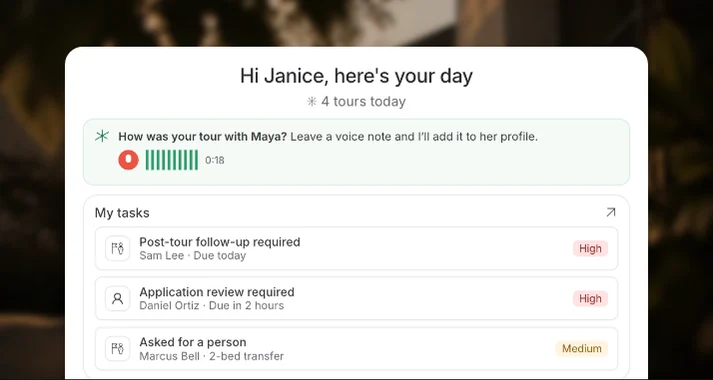
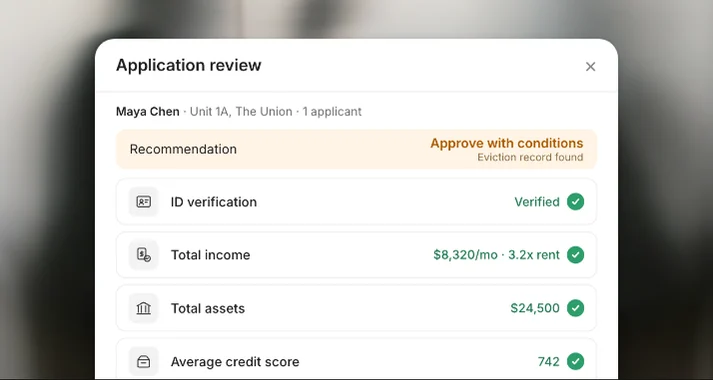
Reviews applications against your criteria and approves the easy ones, staff handle edge cases.

Reviews posts and comments against your community guidelines, then responds or hides them instantly.

Personalizes every leasing conversation to the prospect, not a script, with full team visibility.

Surfaces portfolio-wide risks and trends, and builds whatever custom report you ask it for.

Builds a full first-draft property budget in one click, then scores it and keeps refining with you.

Predicts what residents need, books amenities, files tickets, and follows up, not just answers.

Knows a resident’s full history, so it sends the renewal offer at the right moment, in a human tone.

Finds and resolves ledger discrepancies, matching every posting against the bank record.

Lets onsite teams run free, paid, or ticketed community events, with residents able to RSVP in-app.

Walks residents through move-in and a photo inspection themselves, surfacing paid add-ons too.

Walks residents through move-out tasks, while unlocking new service revenue for their next home.

Gives onsite teams one shared queue to create, assign, and close tasks across every property.

Manages work orders end to end, from resident request through technician dispatch and completion.

Replaces your CRM, lead nurture, and tour tools with one system built for the full relationship.

Tracks every lease, renewal offer, and deadline across the portfolio in one connected system.

One complete profile per resident, with lease, communication, and activity history all in one place.

Complete history of a unit itself: past residents, work orders, everything that happened inside it.

Portfolio-wide view of units, availability, and activity across every property you manage.

Grants and manages granular team permissions and module access across your whole organization.

Controls private-label branding, tone of voice, and experience across every resident-facing surface.

Reaches residents by email, SMS, or app notification, and logs the full conversation history.

Build resident segments from shared traits, then target communications and workflows with precision.

Automates any process, communications, tasks, or reminders, triggered by whatever rules you set.
No application matches that search or filter.
Every application here started as an operator’s problem. Yours can too, built on your Company Brain by a Forward Deployed Engineer.
See how it worksImpact
Gotham connects over a century of real estate expertise with structured data across every function of the organization to build a company brain and lead the next generation of New York real estate.
There’s a moment Ben Picket, Director of Strategic Operations at Gotham Organization, describes that probably sounds familiar to every operator.
“Leasing lives in one system. Renewals in another. Marketing is somewhere else. Asset management information is in another tool.” He pauses. “With everything separate, what we’re missing is understanding how all of those pieces tell the larger story of the tenants who live in our building. What keeps them coming back. What keeps them renewing.”
Ben Picket
Director of Strategic Operations at Gotham Organization
Ben has spent two and a half years on one mission: centralizing that data, and turning it into something Gotham can actually act on.
Founded in 1911, Gotham Organization has shaped New York’s residential skyline for over a century. Their iconic buildings - The Maybury in Midtown West, Gotham West in Hell’s Kitchen, The Suffolk on the Lower East Side - have individual histories, personalities, and residents.
When Ben joined his family business from the startup world two years ago, Gotham’s buildings had an excellent reputation, but there was definitely an opportunity to run more efficiently and personalize the resident experience by organizing the data infrastructure underneath.
They’d tried building their own app, but there was too much maintenance. They tried moving to a popular building management point solution and it was functional, but bare-bones. Not the holistic resident experience Gotham wanted to deliver.
This isn’t an app story. It’s a data story.
Venn is not simply a resident experience platform, and it is not simply an app residents use to book amenities or submit maintenance requests - though it does both.
What Venn builds is your company brain.
Every interaction a resident has - a booking, a service request, a survey response, a renewal conversation, an amenity preference, a communication pattern - generates a signal. Individually, those signals can be noise. But together, organized into a unified data layer and made legible to AI, they become a coherent picture.
Before Venn, Gotham operated on fragments - leasing data here, satisfaction surveys there, and concierge logs somewhere else entirely. The story was all there, but it just wasn’t connected.
What Venn did was build the connective tissue. Not just the app residents use, but the infrastructure that turns scattered operational data into something AI can understand and act on. A small language model trained on Gotham’s portfolio, its residents, and its history.
Ben describes it as “centralizing all of that data and creating real outputs so we can be the best version of ourselves.”
The most important place the brain shows up is at the front desk. Venn’s onsite concierge team, LIVunLtd, operates as an extension of Gotham’s own staff, drawing from the same unified data layer that powers the rest of the system. The result is a resident experience that feels personal and seamless for everyone.
Press
Bozzuto and Venn craft an AI-driven, end-to-end ecosystem that simplifies everything from paying rent to finding neighbors.
Residents are confused. They’re fumbling with a patchwork of apps and outdated systems. Want to pay rent? That’s one app. Collect your package? Another. Oh, and don’t forget the community newsletter in your inbox somewhere, if you can find it.
We’ve been conditioned to expect more. Every aspect of our lives, from streaming Netflix to buying groceries, has been optimized to the point where it feels invisible. The best technology anticipates your needs, simplifies your life, and creates emotional connections. In other words, it works like magic. So why should your apartment experience be different?
Imagine if your living experience was designed like the Apple ecosystem. Everything you need can be delivered in one place. No clutter. No confusion. Just seamless living at your fingertips. That’s the vision Bozzuto and Venn are bringing to life, an artificial intelligence (AI)-powered, end-to-end ecosystem built on a completely new operating model.
“We’ve been quietly developing this for nearly two years. Our mission is to become a ‘love brand,’ where customers, employees, clients, and partners accept no substitutes. To achieve this, we’ll rely on best-in-class technology, efficient processes, and people-first programs.”
Stephanie L. Williams
President of Bozzuto Management Co.
While the industry has been focused on apps, Bozzuto and Venn were thinking bigger, about data and ecosystems. This isn’t just another app cluttering your home screen. It’s an end-to-end platform that seamlessly plugs into all of Bozzuto’s systems, consolidating data and learning with every interaction. Find neighbors with common interests, renew your lease, unlock your door, or schedule a service request? It’s all handled by an ecosystem that’s constantly getting smarter. No matter how you communicate or in which method, it all works your way, your style, and feels like one.
Built on the Venn infrastructure, myBozzuto is an intelligent resident operating system designed to be customizable to the management company’s specs. “The platform learns and adapts with every interaction, making it smarter and more efficient,” says Or Bokobza, CEO of Venn. “This is just the beginning. In the next 18 months, we’ll roll out even more capabilities that will continue to push boundaries.”
But it’s not just about resident convenience. myBozzuto redefines how property teams operate. Instead of navigating multiple dashboards, leasing teams can focus on what truly matters: building meaningful connections with residents. AI handles the routine tasks, making it effortless to scale without adding more staff or sacrificing quality.
Just like Apple’s iOS, the real power of myBozzuto isn’t in the features. It’s in the feelings it creates. It’s not about checking off tasks, but about how effortless, connected, and personalized the entire experience feels. By anticipating needs and simplifying every touch point, myBozzuto makes the entire resident experience feel seamless, almost magical. This is the future where residents don’t just live in a building. They feel at home in a community that understands them.
“We don’t just want residents to renew leases, we want community advocates, people who wouldn’t dream of living anywhere else. This is when we know we’ve achieved our goal of creating a love brand.”
Stephanie L. Williams
President of Bozzuto Management Co.
This article originally appeared in Multifamily Executive.
Impact · September 1, 2026
130 assets. Roughly 40,000 units. More than 50 owners. Kairoi built its own budgeting application on its Company Brain, to the exact specification of its business, in less time than a traditional budget season takes to run.
Kairoi manages 130 assets and roughly 40,000 units on behalf of more than 50 owners, with a budgeting process they have built and refined over years. And like the majority of operators, sophisticated ones included, they run budget season in spreadsheets. Community directors build each property’s budget by hand. Dustin Pyatte, Director of Operations Services, has owned that process across the portfolio for three years.
“We have spent years building a budgeting process that fits how this company actually operates. Every tool we looked at would have meant giving up parts of it to fit someone else’s software. If that is the trade, we may as well stay in Excel.”
Dustin Pyatte
Director of Operations Services, Kairoi Residential
That trade is why most operators are still in spreadsheets. A budget is a commitment. Once it is set, the management company performs against it, and the variance report is where most owner and operator friction happens. An off-the-shelf tool asks the operator to adopt its logic. At Kairoi, the logic was the asset.
Kairoi was paired with a forward deployed engineer with deep expertise in finance and budgeting tooling, working alongside Venn’s chief real estate officer, who spent fifteen years running finance for an owner-operator. He has built these budgets himself, as both an owner and an operator, so he arrived with the context needed to dive immediately into Kairoi’s way.
What made that immediate was how well Kairoi knows their own process. Years of deliberate work meant there was a real model to encode rather than a set of habits to reverse engineer. Most operators have more of that than they realize. It usually lives in one workbook someone has maintained for a decade and in the head of the person maintaining it, and finding it, writing it down, and making it run is the job.
HALO, Kairoi’s Company Brain and operational suite, is built on Venn and already held their data, their roles and permissions, and their general operating knowledge. Financial and operating data flows in from HALO and connectors like RealPage. Market context arrives through Venn’s HelloData connector.
What the Company Brain did not yet hold was how Kairoi budgets. So that is what we encoded: their playbooks, their timelines, their workflows, their formulas. Venn’s forward deployment engineer started by rebuilding their existing budget workbook from the inside, the visible tabs, the hidden accounting, marketing, and software tabs behind them, and the exact upload format their systems expect.
“We tasked Venn’s deployment team with centralizing our entire process. Now we write the budgets and send them out, and the teams edit within the parameters we set for community directors and regional managers. It runs on our own history and our own numbers.”
Dustin Pyatte
Director of Operations Services, Kairoi Residential
Then we built the application people and agents collaborate in. Owner surveys go out first, so each property’s business plan is agreed before anyone builds numbers against it. The agent produces a first-draft property budget in under a minute, and builds it the way an experienced analyst or regional manager would, drawing on that plan, the property’s own financials, its operating data, and market context. It then runs a forensic audit of its own assumptions, flags what needs a person, and shows the logic behind every general ledger line. From there the team reforecasts, compares periods, and runs variance scenarios before it moves up the approval chain to the ownership group.
About ninety percent of what Kairoi needed was general enough to build once. The remaining ten percent was theirs alone, and every line item can be calculated more than one way, so the tool offers the options rather than choosing for them. The judgment stays with the people who own the number.
None of this was a rebuild. The foundation was already carrying the business. We taught it a new skill, and built the surface people use to work with that skill.
April 21. Project begins.
June 1. Proof of concept.
July 15. Budgeting tool delivered to the Kairoi team.
July. Training begins across the portfolio.
August 1. Budget building starts.
Teams are working through their first budget cycle with the new tool and fine-tuning as they go. At the current pace, subsequent seasons are expected to take about two weeks from start to finish for Kairoi’s 130 asset portfolio.
“It has been great working with the Venn deployment team. We have truly built something great, and it is going to change the way Kairoi budgets. It gives our team months back, which means we can grow the portfolio within our current structure and keep pushing ourselves to deliver remarkable service.”
Dustin Pyatte
Director of Operations Services, Kairoi Residential
Everything exports to Excel with the formulas intact, so an owner who wants to keep working the way they always have can. Owners are also invited into the tool directly, where a question about a line item can be asked next to the line item. Kairoi curates what each owner sees, so the view is the part of the business that owner cares about rather than the whole instrument panel. Kairoi invests in shared tooling deliberately, and this is consistent with that: better visibility for the owner, less work for the owner, nothing imposed on the owner.
Reforecasting, variance review, and scenario work all run in the same place the budget was built, against the same assumptions, all year. What Kairoi and its owners agreed to in the business plan stays visible against what is actually happening, which is what keeps both sides accountable to the same document rather than arguing about two versions of it.
Instead of going to market for a budgeting product, Kairoi built their own, to the exact specification of their business, in less time than a traditional budget season takes to run. The foundation was already there. What was left was teaching it their trade.
A budget tool is a budget tool. What matters is the decades of judgment now encoded in Kairoi’s Company Brain, behind every general ledger line it drafts. The application, as impressive as it is, is replaceable. The logic is not, and the logic is Kairoi’s. Another operator can deploy the same tool and end up with something different, because it would be built on their data, their history, and their judgment. That is the whole point of a Company Brain. The tool is the surface. The advantage is underneath it, and it compounds every time you teach it something new.
Partnerships
Related is partnered with Venn to roll out an AI-powered resident operating system across their entire portfolio. The platform captures every resident interaction, translates it into insight, and delivers personalized service in real time.
Partnerships
With Venn, prospects could tour, apply, verify income, and sign all from their phone in a single evening. No uploads. No waiting. Approvals that once took days cleared in under an hour.
It’s not an easy time to lease up a building. Rents grew just 1.2% in the first half of 2025, half the pre-pandemic pace, while occupancy flattened at 94.6%. With supply flooding in, operators are fighting harder for every lease.
Nowhere has that pressure been sharper than Brooklyn, New York’s newly rezoned Gowanus, where 18 developments launched at once against the backdrop of torn up streets and a neighborhood still under construction.
For Charney Cos. and partner Tavros Capital, that challenge was familiar ground. They know Brooklyn block by block, not just where to build, but what to build and who they’re building for. Their projects are grounded in the fabric of the neighborhoods they enter, from unit mix and amenity design to the technology that transforms daily life.
At Union Channel, the first phase of their 2,200-unit Gowanus Wharf project, that local knowledge paid off. Charney leased 80% of units in just five months, while achieving 10% to 20% higher rents per square foot than nearby competitors.
In a sea of clunky desktop portals and dayslong waits for manual screening reviews, Charney wanted to remove all friction from the start. To bring that vision to life, the partners teamed with Venn, a modular operating system that unifies leasing, operations, data, and the full resident experience.
With Venn, prospects could tour, apply, verify income, and sign all from their phone in a single evening. No uploads. No waiting. Approvals that once took days cleared in under an hour.
“We get more applications because the process is easy. Applicants don’t have to dig up tax returns or download PDFs from their bank, everything’s in one place, and it’s mobile-friendly. And because we approve quickly, we dramatically reduce drop-off. When renters wait days for a response, they start applying elsewhere. Speed matters.”
Andrew Steiker-Epstein
Brokerage President, Charney Cos.
The impact was immediate: applications up 42%, approvals under 24 hours, and several hours saved per lease, enough to cut an admin role entirely.
But the real difference came afterward. Residents didn’t just sign leases, they plugged into a community. They paid rent, booked amenities, met neighbors, swapped furniture, and discovered local bars and art installations, all while receiving personalized offers and experiences based on their behavior and preferences. The same technology that streamlined operations also made the building feel alive.
“At the end of the day, what people crave is connection. With Gowanus Wharf, our vision is to build more than just buildings, we’re creating a campus that strengthens community both inside and beyond its walls. It’s about inclusivity, about making everyone feel like they belong. And, with Venn, we now have the tools to bring people together and make them feel seen in ways that simply weren’t possible before.”
Sam Charney
Principal and Founder, Charney Cos.
As Gowanus Wharf’s first phase nears completion, the building is running smoother than ever. By automating routine tasks, Charney freed staff from administrative load, allowing a leaner team to deliver higher performance on-site.
Marvin, the superintendent, walks the halls with his iPad, completing service requests in record time. Joseph, the concierge, greets residents with a smile and can solve almost anything in moments from the Venn hub.
“The real secret to hospitality is giving residents access to a friendly human who can help right away. Instead of making them jump through hoops with artificial intelligence or tickets, we automate the admin work so our team can be present with our guests.”
Andrew Steiker-Epstein
Brokerage President, Charney Cos.
Behind the scenes, Venn’s command center tracks hours saved, giving staff daily proof of their impact and reinforcing that they, too, are cared for.
“When teams feel supported, they show up better for our residents,” adds Steiker-Epstein.
With higher net operating income, faster lease velocity, and leaner overhead, Charney unlocked better debt terms, accelerated refinancing, and increased long-term valuation. What started as a lease-up strategy has become a blueprint for how Charney plans to operate every community moving forward. Charney’s edge has always been knowing the market: what to build, where to build, and who to build for. With Venn, they now know their residents at an even deeper level. That combination of instinct and insight sets them apart, and it’s already reshaping the future of multifamily.
This article originally appeared in Multifamily Executive.
Press
New York has long set the standard for multifamily nationwide. As the country’s most competitive market, it’s where the benchmarks for design, service, and resident experience are defined.
New York has long set the standard for multifamily nationwide. As the country’s most competitive market, it’s where the benchmarks for design, service, and resident experience are defined. What succeeds here sets the pace for the rest of the country.
In less than 12 months, the city’s most forward-thinking owners and operators have partnered with Venn to rebuild the resident journey as a branded, data-driven experience. The goal: create a stronger relationship with residents and scale it across every building.
“At Veris, we’ve built our identity around creating exceptional experiences,” said Nicole Jones, SVP, Marketing & Communications, Veris Residential. “Our partnership with Venn represents a significant enhancement to The Veris Promise. By giving residents meaningful ways to connect with their community beyond rent payments and maintenance requests, we’re building the kind of brand loyalty that transforms how people experience multifamily living.”
In a supply-heavy market, brand equity has become a competitive advantage. With Venn, owners deliver one unified, branded experience across the entire resident journey, and the engagement follows. Veris Residential saw a 300% jump in the first 30 days, giving the system enough behavioral data to learn what residents actually value. That intelligence is already reshaping business strategy.
“The learnings we receive from the platform allow us to build a better building from day one,” said Chris Schmidt, EVP at Related Companies. “That knowledge enhances the resident experience through every stage of design and development.”
By shifting from transactional touchpoints to relationship-based engagement, owners are reducing churn, increasing lifetime value, and scaling portfolio growth without the rising cost of customer acquisition.
“Scale without brand is just more inventory to fill. We’re not just managing properties for owners anymore, we’re building lasting relationships with residents who have unlimited choices. When you can measure how brand and experience drive retention, it stops being a soft metric and becomes core to how you underwrite value.”
Ron Kuntas
CEO, OneWall Communities
As an early Venn adopter, Charney leased up their Gowanus development three months ahead of schedule and earned 20% higher rent per square foot than nearby competitors, proof that this model is as much about identity as economics. “This isn’t about marketing,” said Andrew Steiker-Epstein, Chief Development Officer, Charney Companies. “Residents are loyal to brands they identify with, and that loyalty directly impacts revenue, occupancy, and investor confidence.”
Unlike other off-the-shelf platforms, Venn allows its partners to build on top of an AI-powered framework so the digital experience is completely bespoke to their business. Now owners and operators act like modern consumer companies: building equity through resident loyalty, designing experiences that scale, and measuring how brand impacts performance.
“You don’t win the next decade of real estate by owning more buildings. You win it by owning the loyalty inside them.” said Or Bokobza, Founder and CEO of Venn. “That loyalty positions owners to deliver lifestyle services far beyond the four walls.”
Venn is now in tens of thousands of apartments across the New York City metro and continues to expand in New York and nationwide.
Partnerships
Go behind the scenes of Venn’s first-ever Open House with Veris Residential. Hear how they took 7,000 units live in 45 days and brought their brand promise to life at scale.
This week, we welcomed some of the brightest minds in NYC real estate to our Tribeca office for an intimate evening of conversation, craft cocktails courtesy of The Wooly, and one very real talk about how technology, culture, and operational excellence come together to build standout multifamily experiences.
We kicked things off with a spotlight on Veris Residential, one of the most forward-thinking operators in the industry. The team joined us for a candid fireside chat about their rapid rollout of Venn, the results they’ve seen, and what it means to deliver on a brand promise.
What started as a conversation over the holidays became a full portfolio rollout just weeks later. “We decided to partner with Venn sometime over Christmas. Officially in March, and we went live 45 days later across the whole portfolio,” said Anna Malhari, COO at Veris.
The results speak for themselves: 96% adoption, over $60K in amenity revenue, 100,000+ packages processed, and a resident experience that’s fully connected, branded, and simple.
“There were a lot of other providers offering features we wanted but each as a standalone,” Anna explained. “We didn’t want our residents to have to sign into five different apps. We wanted to make their life easier, not more complicated.”
Veris chose to roll out a single branded experience that felt like an extension of their team and their values. From custom fonts and colors to tailored resident touchpoints, the tech isn’t just integrated, it’s intentional.
Golf groups. Foodie groups. Parents and fitness clubs. According to Area Manager Samantha Saleh, the social features have become one of the most active and loved parts of the platform. “My favorite is the foodie group. There’s always a few recipes on there that I’m checking out.”
Even more impressive? Engagement starts before residents even move in. “People are joining and asking for pediatricians or cleaners, meeting neighbors before they’ve even moved in,” Anna said.
The Veris Promise is their commitment to residents: clear standards, consistent experience. “It’s all the things that are non-negotiable across our properties, from 24-hour maintenance response to a 30-day move-in guarantee,” Anna shared.
Venn is now part of that promise, a daily reflection of Veris’ values, not just a back-end tool.
From QR-code cookies to coordinated launch parties at every property, Veris’ rollout wasn’t just efficient, it was joyful. The team brought a sense of care and creativity to every touchpoint. “Our teams are empowered, and our residents feel it,” said Samantha.
And as the evening came to a close, Veris COO Anna Malhari offered a powerful reflection that captured the spirit of the night:
“Technology will reshape multifamily operations, but the heart of our industry remains human. As we centralize and automate, the real differentiator will be how much more time our teams can spend fostering genuine community, because the future isn’t just digital, it’s deeply personal.”
Anna Malhari
COO at Veris Residential
More Open Houses coming soon.
We’re opening our doors to spotlight the most forward-thinking operators in real estate. Next one could feature you!
Perspectives
Community, risk, purpose and that one time Or’s mom’s FaceTime call was broadcast to the entire Bozzuto boardroom, and what they did next.
At OPTECH 2024, Venn CEO and Co-founder Or Bokobza sat down with Daniel Paulino, former VP of Digital at Bozzuto, for a rare behind-the-scenes look at how two companies aligned around a bold vision, and built a long-term partnership that’s redefining the resident experience.
This wasn’t your typical fireside chat. It was personal, raw, and occasionally hilarious (yes, there was a FaceTime from Or’s mom that lit up the Bozzuto boardroom). But at its core, this conversation was about something deeper: why tech partnerships in multifamily must move beyond features and into shared purpose.
Venn’s journey started in a neighborhood in Tel Aviv, not a boardroom. Or shared how he and his team personally renovated buildings, mapped out a future block by block, and eventually found themselves managing 1,000+ apartments. They weren’t just building software. They were building a vision for how people could live better, together.
That same ethos resonated with Bozzuto.
“We weren’t looking for a feature. We were looking for a future.”
Daniel Paulino
Former VP of Digital, Bozzuto
And that meant approaching innovation differently. Not as a transactional vendor relationship, but as an ecosystem: a way to connect every part of the resident journey, just like Apple connects every part of your digital life.
The conversation highlighted a key trend we’re seeing across the industry: Operators are no longer buying point solutions. They’re looking for platforms that can scale, evolve, and deliver personalized experiences across buildings, markets, and moments in a resident’s life.
“If a prospect has a baby or gets a promotion why do we make them leave the ecosystem to find a new home? What if staying with us made more sense than starting over?”
Daniel Paulino
Former VP of Digital, Bozzuto
That’s the kind of thinking that drives the partnership and product roadmap.
One of the most powerful moments came when both leaders addressed the risk involved. Venn invested millions before a contract was signed. Bozzuto brought in over 40 people across functions to test and shape the vision. And the process took over two years.
But it worked, because it was never just about tech. It was about trust, transparency, and long-term alignment.
Takeaways for operators:
Look for partners, not vendors.
Think beyond the feature. Design for the full resident journey.
Focus on systems that help you scale personalization.
Takeaways for proptech founders:
Show up. Share your vision.
Don’t sell features. Share what drives you.
The right partnerships take time, but they’re worth it.
As we move deeper into an AI-powered era, the most successful operators won’t be the ones with the most tools. They’ll be the ones with the most cohesive ecosystems. Ones that turn data into insight, insight into action, and action into loyalty.
This conversation between Or and Daniel wasn’t just a retrospective. It was a playbook for where we’re headed, and how to build technology that people don’t just use, but love.
Perspectives
NYC rents are rising, tech is booming, and AI is moving in fast. Here’s what industry insiders say comes next.
During the buzz of NYC Tech Week, Venn joined forces with Apartment List to host a panel exploring what’s next for multifamily in New York City and beyond.
Two sharp minds led the conversation: Marc Mathieu, Venn’s new Chief AI Officer and former Head of Global AI Transformation at Salesforce, and Chris Salviati, Head of Economics at Apartment List. While Chris painted a picture of a red-hot rental market, 96.6% occupancy and 4% YoY rent growth, what really stole the show was the bigger question:
What happens when AI becomes core to how we live?
Marc didn’t mince words. He compared today’s AI moment to the dawn of electricity. Right now, we’re still lighting fires, using AI for content and chat. But soon, AI will become the operating layer behind every action, decision, and experience.
For multifamily, that’s more than smart workflows or automation. It’s about transforming operations from transactional to experiential: giving residents personalized, proactive support that feels more like a lifestyle service than a lease.
Marc shared a favorite quote (courtesy of ChatGPT):
“If Alexa can predict what you need, why can’t your landlord?”
That’s the opportunity. To make buildings feel intelligent. To meet renters where they are. And to turn resident data into something that works for them, not just for the back office.
His closing advice to owners and operators?
Get your data house in order. The future is only as smart as your systems are clean.
Find your AI champions. Not everyone will embrace this shift, but some will lead it.
Experiment relentlessly. The only way to stay ahead is to start using AI every day, in real ways.
If you’re building for the future, don’t just adopt technology. Design around it. Your residents are ready. Are you?
Perspectives
Key insights from Apartmentalize 2025 panel on how multifamily operators can leverage proven strategies from Amazon, Apple, and Airbnb to drive revenue and resident satisfaction.
The most successful consumer brands didn’t achieve 35% revenue growth through cross-selling (Amazon), 92% retention rates (Apple), or seamless customer experiences (Airbnb) by accident. In this engaging panel discussion at Apartmentalize 2025, industry leaders Ariel Baranauckas, VP of Marketing at Carter-Haston Real Estate, Christie Bennett, VP of Systems Operations at Willow Bridge, and Andrew Halverson, Senior Director of Strategic Partnerships at Venn broke down how multifamily operators can adapt these proven buyer lifecycle strategies to drive revenue and improve resident satisfaction.
Turn Fee Transparency Into Revenue Opportunity
Amazon attributes approximately 35% of its sales to cross-selling strategies. Instead of presenting residents with a long list of separate fees that feel punitive, successful properties are creating lifestyle bundles that residents actively choose.
Traditional approach: Pet rent + storage fee + carport fee = frustrated residents.
Amazon-inspired approach: “Pet Parent Package” including dog park access, washroom amenity, monthly pet treats, and move-in water bowl
The Psychology of Choice Architecture
Think about your own subscription habits. Most people subscribe to multiple streaming services (Netflix, Hulu, Paramount+) without thinking twice because each feels valuable and chosen. Properties can create this same mindset by:
Letting residents build their lease like a subscription service
Presenting options as lifestyle enhancements, not mandatory fees
Using “frequently bundled together” suggestions like Amazon’s shopping recommendations
A/B Testing Your Bundle Strategy
Don’t guess what works. Test it systematically:
Property A: Traditional separate fees with basic descriptions
Property B: Lifestyle packages with benefits clearly outlined
Track conversion rates, resident satisfaction, and total ancillary revenue
Pro tip: Ask your leasing team for insights. They’ll quickly tell you which presentation style generates more excitement and fewer objections.
Seamless Integration Over Shiny Objects
Apple’s 92% retention rate in the United States comes from ecosystem thinking, not individual product features. When you open an Apple product, everything feels clean, intuitive, and connected. The same principle should apply to property management technology.
The mistake: Adding every new PropTech tool without considering integration
The Apple way: Ensuring every resident touchpoint feels seamless and consistent no matter what device they’re on.
Hidden Complexity, Beautiful Experience
Apple stores hide all the wires and technical complexity while presenting a premium, clean experience. Your residents shouldn’t see the chaos behind the scenes. They should only experience:
Consistent messaging across all platforms
Same colors, logos, and tone throughout their journey
Personalized communication that feels intentional, not automated
Data-Driven Personalization
Apple products feel personal because they learn from user behavior. Properties can capture data during the application process to create personalized experiences throughout residency:
Welcome messages that reference specific amenities they showed interest in
Maintenance follow-ups that feel human, not robotic
Renewal conversations based on their actual community usage patterns
The Snow White Sessions
Airbnb identified 45 distinct moments in a guest journey from initial search to post-stay reflection. They tied specific emotions to each touchpoint, asking: “What should someone be feeling at this exact moment?”
For multifamily properties, this means mapping:
First website visit: Excitement about possibilities
Application process: Confidence in their choice
Move-in day: Welcome and belonging
Maintenance requests: Trust and care
Renewal time: Satisfaction and loyalty
The Operator Experience Matters Too
Airbnb succeeds because they optimize for both guests AND hosts. Your on-site team are the hosts of your community. If they’re overwhelmed with systems and administrative tasks, they can’t create magical resident experiences.
Key insight: One team member had a maintenance emergency on a Monday morning, but the property manager refused to come out of her office because “she had reports to do.” How can overwhelmed operators be hospitable hosts?
Automation Enables Human Connection
Smart automation removes repetitive tasks so your team can focus on relationship-building moments:
Automated welcome sequences handle basic information
System reminders ensure no revenue opportunities are missed
Data tracking shows which residents need personal attention
This frees up staff for the moments that truly matter, like personally addressing maintenance concerns or celebrating resident milestones.
1. Start Small, Track Everything
You don’t need to revolutionize your entire operation overnight. Pick one area:
Application process consistency: stop making residents enter information multiple times
Move-in experience optimization: create a tech-enabled welcome sequence
Maintenance follow-up automation: systematic satisfaction tracking
Track ROI, adoption rates, and resident satisfaction for each change.
2. Cross-Selling for Community Building
When residents don’t qualify for your property, don’t lose them entirely. Amazon-style cross-selling in multifamily means:
Referring to sister properties or portfolio communities
Maintaining positive brand relationships even when saying no
Creating a network effect across your entire portfolio
Remember: “People forget what you say, they forget what you do, but they never forget how you make them feel.”
3. Technology Integration Planning
Before adding new tech platforms, ask:
Does this enhance our existing workflow or complicate it?
Is the integration seamless or will it add more friction?
Can we maintain consistent messaging across all touchpoints?
The goal is Apple-level integration: residents shouldn’t care whether you use one platform or ten, as long as their experience flows naturally from start to finish.
Bundle your amenities and fees into lifestyle packages that residents choose rather than fees they have to pay. Test different presentations and track which generates higher satisfaction and revenue.
Map your complete resident journey from first touchpoint to move-out, identifying specific emotions you want to create at each stage. Focus on consistency across all platforms and communications.
Invest in your on-site team’s experience as much as your residents’. Automate repetitive tasks so your team can focus on building relationships and creating community.
Start with one improvement rather than attempting a complete overhaul. Track results, build momentum, and expand your efforts based on what actually works.
The companies that dominate their industries understand that great experiences aren’t accidents. They’re systematically designed, consistently delivered, and continuously improved. Your residents are already trained by Amazon, Apple, and Airbnb to expect seamless, personalized, valuable experiences. The question is: are you ready to deliver them?
Ready to transform your resident experience? Learn how to leverage data for personalized experiences, create seamless operations, and introduce new revenue streams by applying the strategies that made Amazon, Apple, and Airbnb industry leaders.
Product
As we continue expanding our operational automation suite, we’re introducing automated move-in inspections, reducing hours-long processes to minutes while creating a more streamlined resident experience.
Every onsite team knows the struggle. It’s move-in day, and your leasing staff is juggling clipboards, pens, and paper forms while trying to maintain a professional experience for new residents. Critical inspection details get missed, photos are forgotten, and paperwork gets lost between filing cabinets and email threads.
We heard same story from so many of our partners: move-in inspections were eating up valuable time, creating compliance risks, and frustrating both staff and residents. What should be a quick process was turning into an hours-long ordeal of paperwork, photos, and filing.
Meanwhile, residents expect the same digital-first experiences they get everywhere else. Instead, they get tedious paperwork that sits on their to-do list, while onsite teams get stuck playing follow-up and chasing down forms.
The industry needed a solution that would modernize this critical touchpoint while actually making operations more efficient. So we built it.
Residents complete their inspections directly on their mobile device with simple taps and swipes. Add photos, notes, and assessments instantly. No clipboards, no lost paperwork, no filing headaches.
Capture multiple photos per issue, creating a comprehensive visual record that protects both residents and property owners while eliminating future disputes.
Residents review, add their own photos, and digitally sign off using the same app they already know and use.
Everything lives in one place within your existing platform. Inspection records, photos, notes, and resident signatures are instantly accessible.
Venn’s new Move-In Inspection workflow represents more than just replacing paperwork. It’s part of our commitment to transforming every operational touchpoint into an opportunity for efficiency and exceptional experiences.
This is the same philosophy behind our approach to each part of the resident lifecycle and your team’s day to day. We believe property management should be powered by intelligent, integrated tools that make both staff and residents happier.
As we continue expanding our operational automation suite, Move-In Inspections provides the foundation for predictive maintenance insights, automated compliance reporting, and AI-powered property intelligence that will define the next generation of Multifamily.
Schedule a demo and see exactly how Digital Move-In Inspections transforms your move-in process while creating experiences residents love.
News
In the past 18 months, Venn expanded across 62 cities, partnered with 270 operators, and connected more than 500,000 residents. We’re here to build something big.
Every company has a moment where the story becomes clear, not just to the team, but to the entire market. For Venn, that moment is now.
We announced a $52 million fundraise this week, but the raise isn’t the story. The story is that the industry is finally ready for what we’ve been building quietly, obsessively, and sometimes painfully, for years.
From day one we believed something simple: people who live in buildings are not “tenants,” they are customers. And the best companies in the world (Apple, Airbnb, Amazon) built empires by caring about their consumers, understanding them deeply, and earning their trust at every interaction.
Multifamily never had the infrastructure to do that. Too many systems. Too many silos. Too many broken touchpoints.
You can’t build trust when everything is disconnected.
You can’t build a brand when every interaction feels transactional.
You can’t elevate your business without engaging and delighting your customers.
So we built the system that makes trust possible.
Venn is the operating system that connects every moment of the resident journey into one live, intelligent flow. Search. Screening. Leasing. Moving in. Payments. Communication. Service. Renewals. One system. One identity. One consistent experience.
With Venn OS, operators finally get to know their residents, teams work faster without increasing headcount and every interaction becomes both an emotional and a financial opportunity. In short, Venn empowers operators to build trusted consumer relationships at scale.
This is not about software. It’s about building trusted customer relationships at scale.
People who know us know this: we don’t rush product. We didn’t try to “sell first, fix later” like many companies do.
We wanted to build something that was different, something that would wow the industry the moment they touched it. Beautiful. Seamless. Intelligent. And obsessively simple for everyone who uses it: operators, partners, residents. It took years to perfect the foundation. Years of saying “not yet” instead of “good enough.”
Now that it’s ready, everything changes.
In the past 18 months, Venn expanded across 62 cities, partnered with 270 operators, and connected more than 500,000 residents.
Not installs. Not logos. Actual lives we touch every day.
But the opportunity is even bigger. The living economy, insurance, energy, mobility, connectivity, home services, credit and everything else around how we live, is a $10 trillion dollar opportunity. And the operators who build trusted relationships will be the ones to participate in it. Venn is the gateway.
The next chapter is simple: hyper-scale.
We are now focused on putting Venn in front of as many residents as we can, as fast as we can. Not with hype, with product. Not with promises, with proof. Our goal: 1 million units by the end of 2026.
To get there, we’ll keep doing what we do best:
Doubling down on product and AI.
Turning onsite teams into superheroes.
Helping every operator build their own consumer brand.
Unlocking new revenue streams through trust.
And attracting the best talent without compromising on culture.
This is the moment we’ve been building toward.
We always believed that if you treat people with real care, if you make their lives easier, simpler, more human, the business will follow. And today, after everything we’ve built, we have even more conviction that this is the right way to change this industry.
We’re here to build something big. Something durable. Something that actually improves how millions of people live.
Most importantly, we will keep building with passion, alongside the amazing team who chose to build this the hard way, patiently, thoughtfully, and with rare care. Their dedication created the product, trust, momentum, and belief. We are endlessly proud of the people at Venn who work daily to improve millions of lives; this next chapter belongs to them as much as it does to the company.
And now, finally, the world is ready for it.
Or & Chen
Product
The first AI leasing agent that has a full context of your entire business and uses that knowledge to sell the value.
Independent research mystery-shopping 50+ properties found that AI leasing agents across competing platforms returned nearly identical responses regardless of the community or the prospect. When every AI sounds the same, the tool isn’t selling your community. It’s just answering questions.
Venn AI Leasing Agent is built differently. It learns about the prospect, personalizes every conversation, and sells the value of your community before your team ever picks up the phone.
From the first inquiry, Venn AI Leasing Agent engages with full context. It knows your floor plans, your pricing, your community. It picks up on signals in the prospect’s message, their timing, what they asked, how they asked it, and responds accordingly.
It learns preferences, books tours, collaborates with your team, follows up, sends applications, and even sends leases. Every message is personalized and every conversation builds on the last, so prospects feel taken care of and your team has full context whenever they step in.
Other AI leasing tools are point solutions. They connect to a lead source and a CRM, and that’s the limit of what they know. Venn sits on top of your entire operation: your PMS, pricing, floor plans, resident history, community. When a prospect reaches out, the AI isn’t working from templates. It’s working from everything. That context is what makes the conversation feel different. Not smarter AI. Just AI that actually knows your business.
Conversation history is visible to your leasing team in real time. Handoffs are clean. When something happens in person, the agent asks for a recap and updates its context so nothing gets lost between touchpoints.
When a prospect signs a lease, their profile doesn’t get archived. It becomes their resident profile. Every preference learned, every conversation had, every signal picked up during leasing carries forward. By the time they move in, Venn already knows them. That’s what makes it possible to serve them personally from day one, and every day after.
Venn AI Leasing Agent is the first touchpoint in the Venn Leasing Intelligence suite: a complete leasing stack built to take a prospect from first inquiry to move-in in one platform, with no handoffs and no gaps.
Partnerships
Charney Companies reduced leasing time from 6+ hours to under 1 hour per move-in, generating $231+ in value per lease with Venn’s automated platform at their 2,200-unit Brooklyn development.
Charney Companies is the developer of Gowanus Wharf, a 2,200+ unit mixed-use project in Brooklyn. This case study focuses on Union Channel, the first building in the development, where Charney adopted Venn to manage the entire resident journey from application to move-in. With Union Channel nearly 60% occupied (130 of 224 units), Charney plans to scale Venn across the entire campus as new buildings come online.
At most buildings, leasing is a manual grind: 6+ hours of staff time per move-in, clunky application portals that lead to abandoned applications, and scattered tools that delay approvals and drive vacancy loss, a killer for a new lease-up. Charney knew they didn’t want that. So from day one at Union Channel, they took a different approach.
“With the Plaid integration, we get bank balances immediately,” says Ian Smith, leasing manager at Charney. “On-site required manual work: opening PDFs of credit reports, pay stubs, and bank statements, then compiling those into approval packets for ownership. That’s what slows everything down. Approvals would take two to three days. With Venn, it’s under 24 hours.”
“We used to spend entire days chasing documents and approvals. It could take hours just to send and sign a lease.”
Ian Smith
Leasing Manager, Charney Companies
After implementing Venn, Charney moved to one unified platform that automated every step of the leasing process:
Application, document collection, approval, lease execution, payment, utility setup, move-in checklist.
“Now we can get someone from application to signed lease in under an hour. It’s all automatic.”
Ian Smith
Leasing Manager, Charney Companies
“We get more applications because the process is easy. Applicants don’t have to dig up tax returns or download PDFs from their bank. Everything’s in one place, and it’s mobile-friendly. And because we approve quickly, sometimes within 10 minutes, always within 24, we dramatically reduce drop-off. When renters wait days for a response, they start applying elsewhere. Speed matters.”
Andrew Steiker-Epstein
Charney Companies
At this pace, Charney is set to unlock over $500k in value from Venn by the time the full 2,200-unit campus is leased.
“We think of Gowanus Wharf as a campus, connected buildings, shared amenities, a real community. Venn is the thread that ties it all together. It’s how we give every resident a cohesive, elevated experience from day one.”
Andrew Steiker-Epstein
Charney Companies
When you power the full resident journey, you do more than automate tasks, you build trust. Trust drives engagement. Engagement turns into adoption. And when you’re the platform residents rely on from day one, you unlock significant new revenue opportunities across services, upgrades, and recurring needs.
“We used to be on BuildingLink. This is so much easier, just open the app on my phone and do whatever I need to.”
Sean
Resident
Just as importantly, when the onsite team works from a single platform, it creates clarity, consistency, and faster execution across every step of the resident journey. Venn becomes the team’s one-stop shop for resident communication, task management, and follow-through. This focus lets staff spend less time juggling systems and more time delivering exceptional hospitality.
That’s why an end-to-end platform matters: Higher margins. Stronger loyalty. Smarter growth.
Charney didn’t just adopt new software, they redesigned their operations to scale faster, cut costs, and deliver a better experience. Venn helped them move faster, work smarter, and generate meaningful ROI without adding headcount.
Want These Results?
Own your full resident journey like Charney, book a demo with us today.
Press
After years of struggling with fragmented tech and patchwork solutions, industry leaders like Bozzuto and Related are building resident-first ecosystems.
For years, the multifamily industry relied on fragmented technology. Owners and operators were stuck with third-party solutions that failed to integrate, weakening their brand presence and frustrating property teams and residents. Now, the industry’s most influential leaders are demanding more from their technology partners, and they’re taking control of their digital future.
Many operators tried building their own technology, only to find it expensive and unsustainable. Over 20 point solutions later, they ended up with “Frankenstacks,” disjointed systems that created more inefficiencies than results. Today, the industry is shifting toward a resident-first digital ecosystem fully owned by operators and built in true partnership with technology companies.
“We love our technology partners, but a patchwork of point solutions wasn’t sustainable.”
Stephanie L. Williams
President of Bozzuto Management Co.
Bozzuto had a clear vision: create an exceptional experience for both residents and employees, one that simplifies daily living and removes friction through smart, seamless technology. That vision is coming to life with the launch of myBozzuto, an artificial intelligence (AI)-powered platform built to unify resident interactions and property management tools. “With myBozzuto, we’ve drawn a clear line: this is how we plan to do business moving forward. We’re asking our partners to meet us in a new way, through deeper integrations that give residents and property teams a unified, seamless experience. It’s how we control our data, elevate the customer interface, and, ultimately, own our future,” notes Williams.
The growing number of companies adopting a similar vision underscores a broader industry shift in motion. The industry is moving in the same direction: consolidating systems, surfacing smarter insights, and giving their teams the tools to move faster and deliver more meaningful resident experiences.
“Our goal has always been to lead through experience. This next chapter is about enabling our teams to move faster, stay more connected to our residents, and use data to elevate service in ways that weren’t possible before. It’s a strategic evolution, not just in tech, but in how we run our business.”
Chris Schmidt
Executive Vice President at Related Cos.
Operators are no longer adapting to rigid platforms. They’re partnering with tech companies that flex around their business, not the other way around. The most impactful tools integrate effortlessly into existing workflows, delivering value without disruption.
That’s exactly what Venn and Bilt are building together: a connected, resident-first ecosystem where engagement fuels data, and data powers automation and personalization. Bilt, the largest payment and resident loyalty platform, has partnered with Venn, the technology infrastructure behind Bozzuto and Related’s custom operating systems. Through Bilt, operators layer incentives across the entire resident journey: lease signings, rent payments, reviews, referrals, and more. Now fully integrated, Bilt’s benefits are seamlessly embedded into the private-labeled operating systems powered by Venn.
“The integration we’ve built with Venn represents one of our most comprehensive and native integrations to date. Together, we’re unlocking a flywheel of engagement and performance, from loyalty-driven payments to real-time, personalized experiences. This isn’t just a better resident journey. It’s a smarter business model.”
David Wyler
Chief Business Officer at Bilt
Because Venn powers the full journey, property teams can use Bilt incentives to drive desired behaviors. With Bilt embedded into Venn’s workflows, every interaction drives engagement. Engagement fuels data. Data reveals insights. Insights trigger automation, and automation drives performance.
For too long, property technology was built around accounting systems, with resident experiences treated as add-ons and data locked behind disconnected tools. That’s starting to change. Deep, coordinated integrations like this aren’t outliers anymore. They’re becoming the expectation. As operators consolidate systems and take ownership of their data, the industry is shifting toward something smarter: unified, open, and built around the resident from the start.
This transformation is no longer theoretical. It’s happening in real time and at scale. Owners and operators are no longer stitching together point solutions. They’re consolidating systems, owning their data, and delivering resident experiences that are seamless, personalized, and built for long-term growth.
Bozzuto and Related have made their direction clear: They’re building ecosystems designed for speed, connection, and results. And they’re inviting technology partners to meet them there, through deep, native integration that supports their vision, not fragments it.
“Collaboration over competition is the future. The old model was about carving up the pie. But when operators and tech partners build together, unified around the resident experience, the pie itself gets bigger. Everyone wins. That’s why I always say 1+1=11. Because when the right companies integrate deeply and move as one, the outcome isn’t incremental. It’s exponential.”
Or Bokobza
CEO and Co-founder of Venn
The most forward-thinking companies aren’t waiting for the future. They’re building it. And they’re inviting the rest of the industry to catch up.
This article originally appeared in Multifamily Executive.
Perspectives
Leaders from Willow Bridge, Avenue5, Bozzuto, Bilt, and Venn take the stage at RETCON to reveal how technology and community-building are remaking resident relationships and driving measurable ROI.
The traditional multifamily model is dead. At RETCON 2025’s “Shaking Up the Resident Model” panel, industry leaders made it clear: the era of collecting rent and avoiding tenant interactions is over. Today’s residents expect Amazon-level personalization, Apple-like simplicity, and authentic community connections.
The driving forces behind this transformation are undeniable:
Customer expectations have dramatically shifted.
Competition now centers on customer service, not just amenities.
Every interaction presents monetization opportunities.
The industry can no longer afford to treat resident engagement as a cost center.
Bozzuto’s Kelley Shannon introduced a concept that might sound unusual in real estate: becoming a “love brand.” She defines this as “a brand for which there is no substitution.” Think Apple customers who line up for new devices every two years without considering alternatives.
The business case for love is compelling: When Bozzuto surveyed 3,000 of their best residents, they discovered that 58% felt only moderate community connection, revealing massive opportunity space. More importantly, they learned that residents demand foundational basics first: safety, cleanliness, and responsive management. Only then do they engage with additional services.
“Every interaction is an opportunity to bring humanity. We talk to our residents to make sure that when there is a problem, we’ve got a relationship that will allow us to fix it without it escalating.”
Kelley Shannon
Managing Director, Marketing, CX and Revenue Management at Bozzuto
Venn CEO Or Bokobza outlined how the industry can transform resident services from expenses into revenue drivers through what he calls three key effects:
The Apple Effect: Seamless, Simple Experience
“All those services (dog walking, cleaning, internet) existed forever. But the unified experience connecting all these dots from a month before residents move in until a month after they leave doesn’t exist yet in every building.”
The Amazon Effect: Knowing Residents Better Than They Know Themselves
Centralizing and normalizing resident data enables personalized experiences. “When residents feel this level of love, they stay longer. They feel at home in their buildings, in their neighborhoods.”
The Supermarket Effect: Strategic Service Positioning
Like placing candy at checkout height for children, smart positioning of services and offers can dramatically increase uptake and revenue.
Avenue5’s Approach to Bridging Experience Gaps
Mariya Heath focuses on the disconnect between leasing promises and actual resident experience: “We see room to elevate that living experience versus what we value for amount asked versus value for amount paid. We’ve got to be focused on the full customer journey and filling all those little spaces in between with love.”
Willow Bridge’s Technology Integration Strategy
Trina Williams emphasized that new technology must solve specific problems: “We’re not just going to implement a tool just to implement a tool. There’s an issue that we’re trying to fix.” Her company focuses on communicating clear business benefits: increased retention, higher occupancy rates, and improved online reputation.
The Platform Integration Revolution
Industry leaders are demanding vendor integration rather than managing multiple point solutions. As Kelley Shannon noted, “Six months ago, we told all your vendors and partners: if you want to work with us, you need to work our way and integrate to our platform.” This approach creates seamless experiences for both residents and staff.
The panel emphasized that emotional connection must translate to measurable business outcomes:
Key Metrics Beyond Traditional NOI:
Resident retention rates and reduced turnover costs.
Employee satisfaction and reduced hiring expenses.
Revenue from integrated services (dog walking, insurance, housekeeping).
Online reputation scores and their impact on leasing velocity.
Cross-selling success rates for resident services.
The Flywheel Effect: Better resident experiences create happier, more motivated employees who deliver superior service, leading to higher retention and lower operational costs.
1. Audit Your Current Resident Journey
Survey your residents about community needs and experience gaps. Bozzuto’s 58% response rate proves residents want to engage when asked thoughtfully.
2. Establish Platform Integration Requirements
Tell vendors they must integrate with your chosen resident platform to work with you. This eliminates data silos and creates unified experiences.
3. Shift from Vendor to Partner Relationships
Avenue5 calls vendors “suppliers” to emphasize partnership over transactional relationships. Look for companies that align with your resident experience vision.
Industry leaders predict the next 18 months will be critical for this transformation. Companies that successfully integrate resident experience platforms while maintaining authentic community connections will establish significant competitive advantages.
“The industry is ready. The biggest leaders get it. They’re just trying to connect the dots right now.”
Or Bokobza
Venn
The bottom line: Property managers who continue operating with a transactional mentality will find themselves competing against companies that treat residents as valued customers deserving of Amazon-level personalization and Apple-like simplicity. The choice is clear: evolve or become irrelevant.
Ready to transform your resident experience? Start by surveying your residents about their community needs, audit your current technology stack for integration opportunities, and identify partners who share your vision for resident-centric service delivery.
Perspectives
Aliya Khan, Marriott International’s Vice President of Global Design Strategy and Product Development, sits down with Dan Ryan of Defining Hospitality for a long-form Inner Circle conversation.
She was still working on the train. Aliya Khan, Vice President of Global Design Strategy and Product Development at Marriott International, had been sent brand language for Residence Inn that morning and could not leave it alone. She called her team from between subway cars on the way to 12 Vestry Street: the brand is a kitchen table. You hang out there. You have breakfast there. Maybe two people sit and have coffee. It gathers. It is uncomplicated. It is simple. So stop making it sound like a tech feature.
“Why,” she would ask the room a few hours later, “are we calling it Dynamic Something-Something?”
The room laughed. But the laugh had something else in it: recognition, or the particular discomfort of hearing said plainly a truth you have been circling for years.
Aliya Khan is not the first person to walk into a room full of apartment operators with lessons from the hotel world. She may be the first to come with raw vulnerability and curiosity you’d never get from a conference keynote.
“Why are we calling it Dynamic Something-Something?”
Aliya Khan
Vice President of Global Design Strategy and Product Development, Marriott International
Dan Ryan introduced her, having watched her career from the beginning with the particular pride of someone who knew before everyone else. He’s known Aliya for nearly twenty years, since she was at Starwood Hotels and Resorts.
He describes her career as parabolic, the kind of arc that starts quietly and then shoots sharply upward. Starwood was, for a stretch in the early 2000s, arguably the most innovative hotel company in the world. They created W Hotels. They developed the Heavenly Bed. There were six brands when Aliya arrived. Then came the Marriott acquisition in 2016, and the portfolio became something else entirely: thirty-some brands, more than 9,000 properties across 144 countries, and a loyalty program with over 228 million members.
Her job, roughly translated, is to decide what each brand is, who it is for, and how every physical and experiential choice serves that definition. She describes herself, with deliberate precision, as not Legacy Marriott. The distinction matters. The people who have been there for thirty years are one thing. The people who arrived in the last decade are something slightly different: the ones who do not want the company perceived as dated, who are asking harder questions about who the customer is becoming.
Marriott has thirty-some brands because each one is a commitment. Residence Inn is for the extended-stay traveler who wants something that feels like home. Element is for the health-conscious guest. W is for the person who once wanted the hotel to feel like a club, but has since grown up without losing a sense of style.
citizenM, which Aliya describes with genuine admiration as smart, technology-driven, and replicable, runs three hundred rooms with a staff of just twelve. For context, a comparable hotel of similar size typically employs a hundred or more people across departments. That scarcity forces citizenM to overcompensate on training and human connection in ways most hotels never have to think about.
Each brand is designed, explicitly, at the expense of the psychographic it is not trying to serve. “The moment we force one brand to do everything,” she says, “we are being disingenuous and disrespectful.” “Do one thing. But do it really well.”
Multifamily has not, for the most part, done this. The industry has built thousands of buildings attempting to be everything simultaneously: wellness-forward and family-friendly and tech-first and community-driven and boutique-feeling and institutional-quality. A handful of operators have attempted sub-branding strategies with real results. Most have found the differentiation harder to execute than to envision.
“Do one thing. But do it really well.”
Aliya Khan
Vice President of Global Design Strategy and Product Development, Marriott International
The second hard thing is about data.
Hotels have it in abundance. Every night is a transaction. The feedback is immediate and granular. Marriott’s ITR, Intent to Recommend, is the number the entire organization lives by. Aliya describes the Marriott Transformational Capital Program in which Host Hotels & Resorts invested $800 million in targeted improvements at specific hotels across Marriott’s portfolio, each decision chosen based on data, validated through physical models that housekeeping, ownership groups, and maintenance crews all walked through before a dollar moved.
Phase II is underway for an additional $200–300MM.
Someone in the room offers, almost as a confession: the multifamily industry’s average survey response rate is approximately five percent.
Aliya does not pile on. She does not need to. Marriott makes decisions about Formica color based on decades of nightly feedback from tens of thousands of properties. The multifamily industry is, in too many cases, waiting for someone to hand back their keys before asking whether anything could have been better.
There is a history lesson embedded in the afternoon, and Aliya delivers it without making it feel like one.
For most of its existence, the hotel was exactly what the word implies: a transactional waystation. A clean bed and a clean shower. The lobby was where you waited for your traveling companion to come downstairs. Nobody lingered. Nobody was meant to.
That began to change in the 1990s, when two hoteliers arrived at roughly the same insight from different directions. Ian Schrager, who had co-founded Studio 54 before reinventing himself as the creator of the American boutique hotel, and Barry Sternlicht, who would build Starwood Hotels and originate the W brand, both started asking a different question: why were hotels creating spaces that served only the guests sleeping upstairs? What if the bar and the common areas were compelling enough that people who lived nearby wanted to come? What if the local became the signal to the traveler that this was somewhere worth staying?
“If it’s good enough for a local to come here,” she says, channeling the original logic, “a traveler thinks: I want to stay there too.”
But Sternlicht went further. He did not want his guests to feel like they were in a hotel. The first team hired for W came from Pottery Barn. Their brief was simple: what is good about home? How do you give someone beautiful escapism that still feels residential?
The Heavenly Bed, Westin’s signature product innovation introduced in the late 1990s and still one of the most studied decisions in hospitality history, is, when described plainly, a bed. Dan says this with the pleasure of someone who has been saving the line: “Hospitality’s most innovative achievement of a generation was a bed. Because you go to a hotel to sleep.” Aliya laughs and agrees. Sometimes the obvious thing, done exactly right, is the revolutionary thing.
Multifamily has been watching this evolution for thirty years and borrowing its vocabulary. What has not fully transferred is the hardest piece: the operational commitment to making the experience matter, built into standards and training and daily practice, not just into the lobby renovation.
“Hospitality’s most innovative achievement of a generation was a bed. Because you go to a hotel to sleep.”
Dan Ryan
Host, Defining Hospitality
Marriott has visited apartment operators specifically to study what they are doing. They reached out to Bozzuto some years ago to understand how they created home. Not the feeling of a hotel. Home.
“They wanted to know how we created home,” says Jamie Gorski, who was at Bozzuto at the time. The exchange went both ways.
There is a structural reason hospitality lags here, and Aliya is direct about it. “I think one of the places where hospitality is a laggard is by virtue of the transient nature of people’s stays. People are in and out.” Hotels can reset every twenty-four hours. That is an extraordinary laboratory for testing and iteration. But the experiment ends at checkout. You never see someone’s daughter grow up. You never become the place someone points to when they tell the story of their twenties.
The permanence that multifamily operators sometimes treat as a management challenge is, from where Aliya sits, something closer to a gift.
“The idea that you could build something a person carries through different life stages,” she says. “That is something we are always trying to solve for. But we can only solve it one night at a time.”
There is also the data of daily life, which hotels will never accumulate. Operators who are paying attention know where their residents eat, what they do on weekends, when they are home and when they are not. That is a fundamentally different kind of knowledge than nightly transactional data. The ancillary services, the neighborhood relationships, the texture of ordinary living: none of it shows up in a hotel’s checkout report.
And then there is community. Hospitality has studied it, envied it, and not solved it. Hotel guests do not build real friendships across rooms. They do not walk each other’s dogs or pick up each other’s packages. The particular stickiness of a building where neighbors actually know each other is not available at any hotel at any price point.
“You have longer access to the customer,” Dan says. “You just have not fully figured out what to do with it yet.”
She nods. It is the most generous thing said all afternoon, and also the most demanding.
“You have longer access to the customer. You just have not fully figured out what to do with it yet.”
Dan Ryan
Host, Defining Hospitality
Marriott’s operating philosophy, offered in the context of a larger conversation about what makes a brand endure, is four words: We design for love.
The rest of the sentence is: and when you design for love, the dollars will follow.
It sounds like a poster. It is also a rigorous framework. It means you do not start with the P&L, the asset manager’s spreadsheet, or the investor’s return targets. You start with a human being. You ask what they actually need. You trust that if you answer that question honestly and consistently and at scale, the financial outcome follows.
And the proof is in the decades. Marriott does not think of its guests as one-time customers or even annual ones. It thinks in lifetimes. A guest who discovers W Hotels in their mid-twenties, drawn to the energy, the design, the sense that the lobby is somewhere they actually want to spend time, is not necessarily a W guest forever. Life moves. They start traveling for business. They have children. Their idea of a good trip shifts from one kind of evening to one kind of morning. Marriott designs for all of it. The same guest who checked into W at twenty-five might be in a Westin at thirty-five for a conference, a Residence Inn at forty with kids in tow, and a Ritz-Carlton for a milestone somewhere in between. One identity. Thirty-some expressions of who they might be at any given moment.
The implication lands quietly in the room. Apartment operators rent by the year. Marriott rents by the night. And yet Marriott has a more deliberate strategy for staying close to its customer across a lifetime than most apartment companies do. A resident moves out after two years and the relationship typically ends. The operator who housed them through a new job, a new relationship, a new city, starts the next conversation with a stranger. In hospitality, losing track of a loyal customer that way would be considered a design failure.
“The brands have personalities,” she says. “They are siblings. We are solving for different types of travelers, and the moment we force one to do everything, we lose the plot.”
The question settles over the room quietly, even as the conversation moves on: what would it mean to design multifamily for love? Not for occupancy. Not for NOI. For love. What would actually change?
“We design for love, and when you design for love, the dollars will follow.”
Aliya Khan
Vice President of Global Design Strategy and Product Development, Marriott International
Here is what would change. The person at the front desk would know your name without being told. The maintenance team, the people most residents actually interact with, the ones who show up when something breaks, would be trained the way the best hotels train their staff: make eye contact, say hello, ask if there is anything else you need. Not as a script. As a standard.
The leasing office would not wait for you to hand back your keys before asking where you were going and why. Nobody would move out of an apartment without someone asking, sincerely and not as a checkbox, what could have been different.
The experience would not be designed around the transaction. It would be designed around the relationship.
Danny Meyer, who built some of the most beloved restaurants in New York before writing Setting the Table, has a concept he calls the Hospitality Quotient: the innate warmth and attentiveness that makes the best service professionals who they are. His argument is that this quality is not trained into people. It is recruited. You hire for it. “It’s not about incentivization,” Dan says. “It’s about selection.” The behaviors you want from your team cannot be manufactured from the outside in. They have to already exist.
The practical implication for multifamily is significant. If the industry wants to close the service gap with hospitality, the answer is not a new bonus structure. It is a different hiring philosophy. It is deciding, at the very front of the process, that warmth is a qualification.
Near the close of the session, Dan turns to the room with the question he has been building toward. If we were all sitting here again in 2036, what would you be disappointed we did not build? Did not adopt? Did not have the courage to start?
Aliya does not hesitate. “I would be disappointed if technology had overtaken the spirit of what we do,” she says. “Whether it is multifamily or hospitality or human engagement and community. Technology should light the way forward. I do not want it to dominate.”
It is the most precise thing said all afternoon, and the most broadly applicable. Both industries are navigating the same tension: how do you use technology to free people up for human connection without letting it replace human connection entirely? That is not a technical question. It is a values question. It is, at its core, a design question.
She came in with a great deal. She is leaving with something too: the community problem, the permanence opportunity, the texture of daily life that hotels will never accumulate. These are things hospitality has studied and envied and not cracked.
Multifamily has not cracked them either. But it has the ingredients, the time, and the access. It always has. The question is whether it will decide, finally, that these things are worth designing for.
1. Selection over incentivization.
The best service cultures in hospitality did not get there by rewarding the right behaviors. They got there by hiring people who already had warmth as a natural state, what Danny Meyer calls the Hospitality Quotient. It cannot be manufactured from the outside in. It has to be recruited.
2. One north star metric.
Marriott’s ITR, Intent to Recommend, is the number everything else is organized around. It drives capital allocation, training priorities, and owner accountability. A consistent multifamily equivalent, applied seriously across an organization, would change how money flows in this industry.
3. The physical model.
Before Marriott launches a new room concept, they build it. Every stakeholder walks through it: housekeeping, maintenance, ownership groups. Decisions get made with physical reality in front of them, not a rendering. Most multifamily decisions about design and amenities are still made from renderings.
4. Consistency across a distributed system.
Marriott does not own most of its hotels. It franchises and manages. The guest does not know and does not care. They receive, whether in Duluth or Dubai, something that feels like the same brand. Training, standards, and accountability make the brand travel. Most multifamily operators cannot say the same across their own portfolios.
5. The nightly reset.
Hotels can test anything in twenty-four hours. New service ritual, new programming, new amenity offering: you know by morning whether it worked. Multifamily’s relationship with residents is longer and richer. But the feedback loop is slower, and too many operators have learned to live without one.
Product
Lease terms, move-in date, and rentable items now flow directly from SightMap into Venn. Convert more prospects to residents without the team lifting a finger.
A prospect finds the perfect unit on your website. They choose a move-in date, pick their lease term, then they hit Apply, and every selection disappears. The data resets and the momentum dies.
When a prospect selects a unit in Engrain’s SightMap, their move-in date, lease terms, rentable items, and full fee breakdown pass directly into the Venn application flow. The leasing process picks up exactly where the search left off, with no re-entry required.
For Residents
Pricing is accurate and transparent from selection through application, lease signing, and move-in.
The right rentable items surface at exactly the right moment, making it easy to add what they need before they even think to ask.
The whole experience is mobile-friendly, remembers where they left off if they have to step away, and nudges them to complete the process.
For Leasing Teams
Every application arrives with full prospect context already attached: selections, documentation, and an AI recommendation on their approval status.
Move-in fees are calculated automatically and presented in a clean summary view, rentable items included. No jumping to the PMS calculator, just review, approve, and the full breakdown goes straight to the future resident for easy payment.
For Operators
Online shopping to lease conversions improve because the friction that killed momentum at the Apply moment is gone.
Parking, storage, and other rentable items are captured automatically in the leasing flow at the moment of highest intent, without any extra effort from the team.
From the first selection, Venn starts building a rich data profile of who that resident is, what they value, and what it will take to keep them.
Every new connector makes your operating system built on Venn smarter and more automated. The Engrain connector is one of the most consequential we have built because selection intent is the earliest signal a resident sends. It is the moment they raise their hand and say: this is my home.
From that moment forward, every interaction becomes data. Every preference becomes signal. And over time, that signal compounds into something operators have never had before: a complete picture of their resident, and what it takes to keep them happy for the next few years.
Product
How Veris and Venn partnered up to reimagine package management using AI to save 7.5 hours/week per community and empty package rooms 40% faster.
Veris Residential is an owner-operator managing more than 6,500 Class A apartments across the Northeast. Known for creating elevated living experiences with a focus on sustainability, Veris sets the bar for what modern luxury living should feel like and expects its technology to deliver at the same level.
One of its flagship communities, Sable, was recently the testing ground for a new approach to package management. With thousands of deliveries every month and a nonstop flow of traffic at the concierge desk, Sable offered the perfect environment to design, test, and scale a better way to handle one of the industry’s most exhausting tasks.
In modern multifamily operations, package management is unavoidable, and for many communities, inefficient. Most Veris communities receive hundreds of packages daily, with each parcel previously requiring roughly 80 seconds to log. Even well-trained concierge teams are limited by the sheer volume, which keeps them in the package room, not engaging in higher-value resident interactions. Existing industry “solutions” often introduced additional complexity through fragmented platforms and unreliable notification systems.
“Packages were one of the most manual, labor-intensive processes onsite. Fixing that workflow was critical.”
Frank McAdams
Vice President, Innovation, Veris Residential
Veris partnered with Venn to build a native package solution within the Venn platform.
Unlike other package tools that operate outside multifamily operational systems, Quick Scan is built into the same platform already storing your resident data. Our AI layer then instantly matches each label to the right resident, regardless of errors or incomplete addresses, and logs the delivery in just four seconds.
“With my old tech, it took me close to a minute to log a package. Now I point the tablet at the package, and it’s done: name, unit, notification. It even suggests the right resident if part of the label’s missing.”
Tyreese Barfield
Concierge/Resident Coordinator at Sable, Veris Residential
The results.
200K+ packages logged in the first 2 months.
7.5 hours saved weekly per community.
15K packages processed each week.
Packages are collected by residents 40% faster.
1,344 hours saved in 70 days across 7K units.
“Time savings give our concierge teams more capacity for high-value, resident-facing interactions. At Class A properties, that level of service is the expectation, and Venn helps us deliver it.”
Dana Sente
VP, Organizational Development, Veris Residential
What Veris proved at scale demonstrates new possibilities for the broader industry. If a large operator managing 220,000 units achieved the same efficiency, the impact could equal:
224,000 staff hours saved per year.
$3.47 million in time value reclaimed annually (based on industry average onsite staff wages).
In other words, every second saved in the mailroom adds up to hours of resident connection across an entire portfolio.
Creating this solution was a true collaborative process. Veris was hands-on from day one. Leadership defined priorities, onsite teams tested early versions, and Tyreese provided frontline feedback that shaped how the system’s intelligence layer behaves today.
“The Veris team were partners in the vision and the implementation. Every insight helped make Quick Scan what it is.”
Janna
Product Manager at Venn
This creates space for what comes next. Now that teams can handle packages in seconds, Veris is already exploring new resident services.
Package management will always be a grind, but it no longer needs to be the kind that consumes a whole day.
With AI and resident-data intelligence doing the heavy lifting, Veris teams now scan in four seconds, save hours each week, and spend that time where it counts: with residents.
Product
Smart, secure visitor management that integrates seamlessly with your existing operations.
Every onsite team knows the drill: vendor shows up unannounced, resident’s guest can’t get in, and your team is scrambling between paper logs, phone calls, and physical keys. Meanwhile, residents can’t manage their own visitors and your staff spends hours playing coordinator for every vendor and guest.
The feedback from our community is clear: guest management creates daily coordination nightmares and constant interruptions, while residents expect modern access but get outdated systems.
The industry was ready for a fundamental shift in how guest management works. So we built it.
Residents manage guest check-ins, recurring visitors, and digital keys directly through their mobile app with simple taps and swipes. Schedule visitors, send digital access codes, and track arrivals instantly.
Teams track vendors and visitors with a real-time dashboard that shows who’s coming, when they’ll arrive, and how long they’ll stay. Get instant notifications and maintain complete security oversight without the paper logs.
Everything lives in one place within your existing platform. Guest schedules, access codes, visitor logs, and security records are instantly accessible. No more hunting through paper logs or separate systems.
“My favorite part of the myVeris app is how seamlessly it handles visitor management, it makes everything from guest entry to delivery notifications feel effortless. I love that I can pre-register guests with just a few taps, get real-time updates, and avoid any awkward delays at the front desk. It’s like having a digital concierge in my pocket. It’s efficient, intuitive, and makes living in the building feel that much more elevated.”
Matthew
Resident at Veris Residential
Guest management represents how Venn thinks differently about property technology. Instead of building isolated solutions, we’re building an operating system where every component amplifies the others.
When guest management becomes part of your living concierge system, it plugs directly into the resident lifecycle, connecting move-in workflows, package operations, and every other resident touchpoint. This isn’t just automation. It’s operational intelligence that gets smarter with every interaction.
The magic happens in the connections: more automated touchpoints create more data clarity, which drives higher resident engagement, which delivers measurably better operational results.
Schedule a Demo and see exactly how “Guests” transforms your visitor management while creating experiences residents love.
Product
Log package deliveries in under 3 seconds with a tablet experience built for speed and accuracy. Scan packages, auto-populate details, and send instant notifications.
Every team with a package room knows: deliveries pile up, residents call about packages that may or may not have arrived, and the team spends hours logging, sorting, and coordinating.
Property teams across our portfolio kept raising the same issue: package management was consuming too much time and turning simple deliveries into multi-step manual coordination nightmares.
Meanwhile, residents expect real-time visibility but get outdated systems that leave them guessing.
It was clear the industry needed to rethink package operations entirely. So we did.
Log deliveries in under 3 seconds with a tablet experience built for speed and accuracy. Scan packages, auto-populate details, and send instant notifications.
Residents get instant notifications and automatic reminders about their packages, with real-time visibility into pickup status. No more calling the office, no more wondering if deliveries arrived. Complete transparency through the platform they already use.
Everything lives in one place within your existing platform. Package logs, resident notifications, pickup confirmations, and delivery analytics are instantly accessible, from your desktop or tablet.
“I’m impressed that the Quick Scan feature can still identify the correct resident and apartment, even in tricky situations like when someone leaves off their apartment number and uses both their English and birth names, or when a last name is shared by multiple people (we have six residents with the same last name!) and it still gets it right. It even handles partially obscured or incomplete apartment numbers, like interpreting ‘25’ or ‘250’ correctly when the label cuts off ‘2505’. It’s been surprisingly smart and accurate.”
Tyreese
Concierge at Veris Residential
As package management integrates into your living concierge system, it creates new opportunities beyond basic delivery tracking. For example, when residents are away and packages arrive, offer secure in-unit delivery for a fee instead of letting packages pile up in the mailroom. You’re not just tracking deliveries. You’re building an interconnected experience where each package touchpoint creates both operational efficiency and revenue opportunities.
Every automation creates operational clarity, which boosts resident engagement, which drives measurable results. Standalone package systems can’t access the resident context, operational data, and workflow connections that make automation truly intelligent.
Schedule a Demo and see exactly how Package Management transforms your mailroom operations while creating experiences residents love.
Perspectives
The traditional property management stack was built around accounting, and it shows. Venn joins Fifth Wall to talk about the next generation of Proptech.
Full webinar is available for partners of Fifth Wall.
Venn CEO and co-founder Or Bokobza was recently featured in Fifth Wall’s Startup Showcase alongside the founders of Surface and Ender, a private webinar for LPs and industry insiders exploring the future of property management systems. The conversation brought together founders leading the charge in automation, AI, and resident experience, and Venn’s vision was front and center.
The traditional property management stack was built around accounting, and it shows. In a landscape dominated by decades-old ERPs, operators are juggling fragmented workflows, disconnected data, and dashboard overload. Point solutions help, but they often create more complexity than they solve.
Venn flips the model. We don’t just digitize workflows. We orchestrate and automate them, turning every touchpoint into a better resident experience, and every experience into usable, high-quality data.
“The property management stack won’t look the same in five years. And it shouldn’t.”
Or Bokobza
CEO and Co-founder, Venn
1. The End of the Dashboard Era
All three founders agreed: too many disconnected tools have created app fatigue and workflow chaos. The industry needs less fragmentation and more orchestration.
Takeaway: Operators don’t need more dashboards. They need fewer logins and smarter automation.
2. AI Is the Baseline, Data Is the Advantage
Everyone has access to AI models now. The real differentiator is how you use your data to personalize and improve workflows.
Takeaway: Data leads to a better experience, a better experience to more usage, and more usage to better data. This is the loop that wins.
3. One Size Doesn’t Fit All
Flexibility was a key theme across the discussion. Every property and team works differently, and the tech needs to adapt, not the other way around.
Takeaway: Customization isn’t a feature. It’s a necessity for adoption at scale.
4. From ERP-Centric to Workflow-Centric Thinking
Legacy platforms are built around accounting. Today’s platforms need to focus on action: helping teams do the work, not just report on it.
Takeaway: The next-gen OS for property management starts with workflows, not spreadsheets.
Press
Or Bokobza, CEO & Co-Founder of Venn, joins NYSE Floor Talk
The bell-ringing ceremony is truly a moment: 30 seconds that captures the years of effort and dedication poured into building something meaningful. I was honored to be invited to the IPO Readiness Workshop hosted by the NYSE and Poalim Tech leadership teams alongside 14 other CEOs. Each of us is at an inflection point, driving our companies with a vision for the long term.
Bhavan Suri’s market overview was packed with insights and Judy Khan Shaw made the NYSE Floor Talk interview feel like a genuine conversation about Venn’s journey and future milestones. Huge thanks to Poalim and the NYSE for putting together such an impactful workshop.
Perspectives
The Inner Circle is quietly becoming the most important room in the industry. No panels. No pitches. Just the owners, operators, and tech leaders shaping what comes next, together.
In an industry often defined by incremental change and siloed decision-making, a new initiative is aiming to shift the paradigm. It’s called The Inner Circle, and it’s quietly becoming one of the most compelling experiments in multifamily innovation.
Founded in early 2025, The Inner Circle is not a traditional conference, a networking group, or a vendor showcase. Instead, it’s a curated, action-oriented forum that brings together property owners, operators, and technology leaders, three often-disconnected voices in the multifamily ecosystem, into one conversation.
The idea is simple but ambitious: get the right people in a room, strip away the pretense, and confront the industry’s biggest challenges together. The result is part think tank, part roundtable, and entirely focused on impact.
The Inner Circle lives at the intersection of three perspectives. Imagine a Venn diagram with one circle each for owners, operators, and tech creators. Where they overlap, that’s the Inner Circle. And it’s where, according to its founding members, “barriers come down and meaningful change begins.”
On February 25, 2025, the group convened for the first time in a sunlit loft in New York City. The atmosphere was intentionally informal. No panels. No keynotes. Just candid conversation among decision-makers who rarely get to speak honestly and directly to each other.
Led by Stephanie Fuhrman, former Managing Director of Global Innovation at Greystar and now SVP at Entrata, the group dug into the gritty realities of tech adoption. Real stories were shared. Hard truths surfaced. And from that, three core challenges emerged:
1. The Cost of Innovation. How do we fund new technology in a margin-constrained industry, and what happens when the resident becomes the business model?
2. The RFP & Pilot Process. Why are good ideas so often strangled by bad processes, and how do we build a better way to test and scale innovation?
3. 1+1=11. What leverage do operators really have against legacy systems, and what happens when we act together instead of alone?
Each of these themes is now being explored through working groups, open-source toolkits, and ongoing cross-functional collaboration.
Part of what sets The Inner Circle apart is what it refuses to be. There are no sales pitches. No passive listening. And no patience for vague talk about “innovation” without execution. The group focuses instead on real-world impact: How are residents affected? How do onsite teams manage change? How do we measure success?
And perhaps most notably, it’s inclusive by design. While curated, the Circle is always expanding. Industry professionals can nominate themselves or others to join future sessions.
The Inner Circle is already producing tangible outputs. Volume 1 of their print magazine, styled like a high-art design and architecture publication, captures stories, frameworks, and insights from that first gathering. It’s part recap, part manifesto, capturing not just what happened, but why it matters and where we go from here.
The long-term goal? To create standards, playbooks, and coalitions that accelerate real progress across multifamily.
Want to add your voice to The Inner Circle? Ready to build what’s next? Nominate yourself or another industry visionary here: the-inner-circle.co
Press
Inside the tools reshaping real estate and how Charney used Venn to lease faster and operate smarter.
Excerpt from Bisnow article.
Charney Brokerage President and Chief Data Officer Andrew Steiker-Epstein said the developer partnered with Venn to create a custom Gowanus Wharf app focused on creating a superior resident experience and streamlining operational processes. Tenants start by going through a full move-in checklist where they can seamlessly book a moving company, reserve the building elevator, sign up for utilities and cable/internet, pay rent, receive their digital keys and more.
“As a tenant, they have access to a social experience, which consists of a variety of community groups. They also have the ability to reserve amenities, sign up for fitness classes, create/RSVP for building and neighborhood events, send maintenance requests and more. We currently have a 98% adoption rate and an 85% engagement rate on the app.”
Andrew Steiker-Epstein
Brokerage President and Chief Data Officer at Charney Companies
Steiker-Epstein said that Charney used Venn to create a custom application for the lease-signing process that allows tenants to go from logging in to the app to lease signing in less than five minutes.
“Our app process allows tenants to sign in directly to their bank accounts and payroll providers to quickly verify income and assets, along with facial recognition to match their ID, and undergo a credit/background check,” he said. “They can do this from their phone.”
Through the use of this app, Charney has noticed a 45% improvement in its drop-off rate compared to the previous processes, he said. The company also uses an AI leasing tool, Zuma, that automatically responds to inquiries and schedules tours by booking slots on its leasing agents’ calendars.
“This has increased our tour volume by over 100% and tour conversion by 20%,” Steiker-Epstein said. “In just three months of opening, we’ve had 1,209 tours.”
This article originally appeared in Bisnow.
Perspectives
A live conversation with leaders from Avenue5, Willow Bridge, and Airbnb, answering the questions people usually dodge.
Introducing Hot Takes: Multifamily Most Unfiltered Podcast, a limited crossover show from the creators of Life After Leasing x Modern Multifamily.
Sydney Webber, Host of Life After Leasing and Mike Wolber, Host of Modern Multifamily hit the road to ask very important people very uncomfortable questions. Why? Because life is short and we want to be entertained while we learn.
First stop: Dallas.
Who’s on the hot seat:
Trina Williams, VP of Operations & Performance, Willow Bridge
Sheri Killingsworth, AVP of Marketing Operations, Avenue5
Jonathan Shaver, Head of Real Estate Partnerships, Airbnb
1. Conferences aren’t dead, but attendance is being earned
When asked whether multifamily conferences are “in or out” for 2026, the answer wasn’t binary.
“They’re in, but they need to be more curated and more in tune with the actual issues we’re dealing with.”
The group agreed that the days of showing up just because “that’s what we’ve always done” are over. Operators want specific problems solved, not more swag, not more panels for the sake of panels.
2. AI is welcome until it touches money or trust
AI came up quickly, and the sentiment was consistent across operations and marketing.
“AI is great for those easy little touchpoints… but when it’s dealing with my money or my time, I need to talk to a person.”
Efficiency matters, especially with leaner teams. But no one on stage believed AI should replace human judgment in moments that affect residents directly. The line between efficiency and experience is thin and easy to cross.
3. Dallas renters say price matters most but they flex more than you’d expect
Apartment List data shared live showed that 63% of Dallas renters say price is their top priority, well ahead of location or amenities.
However, renters routinely:
Lease above their stated budget.
Compromise on “must-have” amenities.
Choose service and responsiveness over features.
“They’re willing to pay more for being supported and cared for, not just a great pool or a cornhole set.”
In a market with elevated supply and longer lease-up times, experience still plays a decisive role once a renter engages.
This conversation took place on February 3rd, 2026 and reflects where multifamily is right now: more scrutiny, less patience for noise, and a growing demand for clarity, from technology, from events, and from each other.
Perspectives
In this in-depth conversation, Or Bokobza, co-founder of Venn, shares the inspiring journey of transforming a big dream into a groundbreaking operating system for modern living.
Most PropTech startups rush to market with MVP solutions, but Venn took the opposite approach. The company invested $70 million and five years building their platform before generating a single dollar in revenue, a strategy that recently paid off with their partnership with Bozzuto, one of the industry’s most respected property management companies.
Venn’s journey began with founders who personally acquired and managed 1,000 apartments to understand operational realities. “We dreamt about a place where you can walk down the streets and see familiar faces, where the barista knows you by name,” explained the CEO. This hands-on experience revealed why most PropTech solutions fail: they address individual pain points without understanding the complete resident lifecycle complexity.
The team discovered that each phase of resident interaction, from pre-leasing through move-out, involves 5-15 different solutions, creating fragmented experiences for both residents and property managers.
1. The Apple Effect: Build intuitive design requiring zero training. “I want my mother to be able to run every building in the world without onboarding,” the CEO told his development team.
2. The Amazon Effect: Leverage data for personalized experiences. Like Amazon’s recommendations, Venn’s platform learns resident preferences to anticipate needs and automate responses.
3. The Supermarket Effect: Use behavioral data to optimize workflows. The platform automates over 35,000 different operational workflows based on proven efficiency patterns.
Rather than pursuing rapid expansion, Venn focused on selective partnerships with quality-focused property managers. After launching with 500 units in 2022, they’ve grown to 200,000 apartments by prioritizing service excellence over speed.
The Bozzuto partnership exemplifies this approach: negotiations took two years, demonstrating both companies’ commitment to long-term success over quick deals.
Venn’s patient approach challenges the typical PropTech playbook of fast iteration and rapid scaling. By investing deeply in comprehensive solutions and strategic partnerships, they’ve positioned themselves as a platform rather than a point solution in an increasingly fragmented market.
Key Takeaway: In complex industries like multifamily, depth and integration often matter more than speed to market. Property managers dealing with operational fragmentation may find more value in comprehensive platforms than additional point solutions.
Perspectives
Venn didn’t start with tech. It started with a radical idea: What if resident experience was your greatest growth engine?
Or Bokobza and Chen Avni join Proptech Pulse for episode 025, “From Code to Community: How Venn Is Reimagining Multifamily Living,” published on YouTube by Multifamily Media Network.
Most PropTech companies start with a technology problem. Venn started with a dream: creating a neighborhood where you know your neighbors’ names. That vision now powers hundreds of buildings across 24 states.
Or Bokobza and Chen Avni’s journey began with a radical experiment in Tel Aviv’s south district. They purchased 30% of an overlooked neighborhood and manually created the resident experience they wished existed, connecting every touchpoint from apartment search to move-out.
The results spoke volumes: property values quadrupled within five years, and residents became advocates who brought friends and stayed longer because they felt part of something meaningful.
After proving their concept worked, Or and Chen faced a pivotal 2018 decision: how to scale their high-touch approach. They spent five years building a comprehensive platform with nearly 100 people, 70-80% engineers, product designers, and customer success specialists.
“No one cares about another app. Residents want experiences that make their lives easy, not more technology to manage.”
Or Bokobza
CEO & Co-Founder of Venn
Chen introduced Venn’s framework for effective multifamily automation:
Automate the Boring, Amplify the Human. Free staff from tedious tasks to focus on value creation.
Data Without Action is Just Noise. AI insights only matter when they lead to immediate improvements.
AI That Feels Personal Wins Every Time. Real-time personalization beats generic chatbots.
Your Tech Stack is Either an AI Goldmine or a Killer. Systems must integrate or AI can’t work.
Think Beyond Cost Saving: Focus on Revenue Boosting. The real opportunity lies in new revenue streams.
Venn has identified approximately $1,500 per unit annually that external companies capture while property owners receive zero benefit. This untapped revenue exists in services, amenities, partnerships, and resident engagement opportunities.
“When you have trusted relationships with your customers, you become the one source of truth for the living experience,” Or explains. This trusted position unlocks monetization opportunities beyond traditional rent collection.
The industry’s obsession with point solutions has created fragmented ecosystems that frustrate both residents and staff. Regional managers leave because they’re juggling 12 different Yardi instances. Residents need “MIT developer” skills just to pay rent.
“In the future many point solutions in our industry may not exist if they’re solving something small and less relevant to the big picture.”
Or Bokobza
CEO & Co-Founder of Venn
Getting AI-Ready: Start with Data
Only 10% of US owners and operators have centralized, normalized data, the foundation for effective AI. Or emphasizes: “AI became commodity. Everybody has access to AI. The differentiator is having clean, integrated data.”
Venn helps partners centralize their data, then provides Zapier-like workflow automation that lets operators build custom solutions in real-time.
“The flow should be happy employee, happy resident, great business.”
Chen Avni
COO & Co-Founder of Venn
When staff struggle with 27 different logins, they can’t deliver exceptional service. Streamlined technology eliminates friction for staff, naturally improving resident satisfaction and business results.
Start with human needs, not technology: Venn’s success stems from obsessing over resident experience first, then building technology that enhances relationships.
Data infrastructure is everything: Before implementing AI, centralize and normalize your data. This foundation determines success or failure.
Think ecosystems, not apps: The future belongs to comprehensive platforms that eliminate friction across the entire resident journey.
Focus on revenue opportunities: The real value lies in new revenue streams from trusted resident relationships, not just operational efficiency.
As multifamily faces staffing shortages and economic pressure, Venn’s approach offers a blueprint for using technology to strengthen rather than replace the human elements that make communities thrive.
Perspectives
Whether building elite teams in the military or world-class companies, Or emphasizes that everything begins and ends with people.
Listen to the full episode, “Or Bokobza: The Impact of Community and the Journey Beyond Wealth,” on the Humans of Multifamily Podcast from Zuma, on YouTube.
This conversation between Or Bokobza and Shiv Gettu, founder of Zuma, was recorded from the Zuma RV as part of Shiv’s cross-country tour to foster real, human connections in the multifamily industry. Instead of relying on traditional networking, Shiv’s podcast project aims to cut through the noise and highlight the people behind the products. This episode dives deep into leadership, community, and what it means to build with heart.
Raised in a close-knit Israeli family, Or learned early the value of hard work, resilience, and community. His decade in an elite military unit refined those lessons, instilling in him the importance of trust, mission-driven leadership, and the power of a tightly bonded team.
After his service, Or ventured into real estate and entrepreneurship, eventually co-founding Venn to reimagine apartment living. Rather than seeing buildings as simple assets, Venn treats them as hubs for human connection, unlocking value through community engagement, seamless resident experiences, and shared ownership.
People First, Always
Whether building elite teams in the military or world-class companies, Or emphasizes that everything begins and ends with people. Authentic relationships, built on trust and mutual respect, are the foundation of successful ventures.
Ownership Drives Engagement
Or believes deeply in shared ownership: not just of equity, but of mission and experience. When residents and team members feel like something belongs to them, participation and value creation naturally follow.
Community is the New Amenity
Venn turns buildings into neighborhoods, and neighbors into collaborators. By fostering real relationships and giving residents tools to shape their living experience, Venn elevates everyday life into something meaningful.
Seamlessness + Belonging = Transformation
Combining tech-enabled seamless living with emotional connection creates the flywheel for transformation. This participation generates behavioral data, enabling personalization that drives retention, efficiency, and new revenue.
Collaboration Over Competition
Or challenges the industry to work together rather than compete in silos. By sharing knowledge, APIs, and ideas, we can unlock a larger pie for everyone and design living experiences that scale both value and humanity.
Or Bokobza’s story is a powerful reminder of what’s possible when we lead with values, trust our instincts, and build with people at the center. At Venn, we’re not just creating products. We’re cultivating belonging. And in that belonging lies the future of living.
Impact · August 26, 2026
The bad debt reserve estimates how much of a company’s receivable it will never collect. It lands on the P&L.
The bad debt reserve estimates how much of a company’s receivable it will never collect. It lands on the P&L. At this operator one accountant builds it by hand in Excel on the first day of close, for every property at once, and the rest of the close waits behind it.
July’s export was 27,407 rows. In one recorded session Excel choked on a filter, the accountant had to force-quit, autosave had not fired, and he started the cleanup over from the raw file.
Then, back on the clock, he hit a seventy dollar variance and set it aside to investigate later. Then a retail pivot that was not picking everything up. Set that aside too. Both were the right call under time pressure. Both mean a number moved toward the ledger with its check unfinished.
The agent does the cleanup and rebuilds the workbook, then runs ten checks and cannot skip any of them. Where the numbers have to match exactly, they match to the cent or the run stops rather than hand over a figure that looks right. Where a small difference is allowed, it reports the amount and where it came from instead of leaving someone to go hunting. Anything it cannot resolve gets named: a property missing from the schedule, a reserve capped because it came out larger than the money owed. Every close ends with a log of what passed and what needs a person.
The rules are theirs: which charge codes roll to which allowance account, which lease stages trigger a reserve, the ten dollar tolerance, and a retail table their field team refreshes each quarter. No vendor could have supplied those, which is why the same build for a different operator produces a different agent.
Nothing posts without a person approving it. The difference is that the person is now approving a checked number.
10 checks. Completed and logged on every run.
To the cent. Tie-out tolerance, or the run stops.
The retail reserve is still human judgment, refreshed quarterly with the field team, and it should stay that way. The open question is where the line sits between a rule worth encoding and a judgment worth protecting.
Operator. Owner-operator, residential plus retail and corporate housing.
Portfolio. All properties on a single monthly close cycle.
Shipped. Bad debt agent.
Layer. Agents.
Build. New build.
Runs. Monthly, on the first day of close.
Status. In build.
Impact
Ron Kutas of OneWall demonstrates that workforce housing’s overlooked complexity was never a liability, it was training. As capital demands operational clarity, operators who built discipline under pressure are positioned to lead.
Meet Ron Kutas. Kutas didn’t get the memo that workforce housing was supposed to be unglamorous. As CEO of OneWall, he manages more than 6,000 units across eight states. Over the last six months, OneWall has been able to double its fee-managed business while helping owners increase their net operating income (NOI), slash maintenance response time by two-thirds, and increase retention threefold. No new hires. No magic. Just smarter, streamlined operations. He sat down with Or Bokobza, CEO of proptech firm Venn, for a conversation that was equal parts strategy session and industry therapy.
Bokobza: Let’s start with the thing nobody wants to say out loud. Workforce housing has been treated like a second-tier asset class for a long time. Is that fair?
Kutas: It’s fair in the sense that it’s been true, but I’d push back on the framing a little. It’s not that workforce housing was overlooked because it wasn’t worthy of attention. It was overlooked because it’s hard. The margins are thin, the operations are complex, the residents have real needs. There’s no room to hide. I think a lot of capital, a lot of platforms, a lot of the industry conversation just … took the path of least resistance and went where it was easier.
Bokobza: So the proptech world went chasing luxury lease-ups and left this whole segment to figure it out alone?
Kutas: Basically. What happened is the operators who stayed in this space got pretty good. Because they had to. You can’t survive in workforce housing on instinct alone. You develop a kind of operational discipline that I genuinely don’t think exists at the same level anywhere else in multifamily.
The operators who stayed in this space got pretty good. Because they had to. You can’t survive in workforce housing on instinct alone. You develop a kind of operational discipline that I genuinely don’t think exists at the same level anywhere else in multifamily.
Ron Kutas
CEO, OneWall
Bokobza: Yet those same operators are often running on infrastructure that hasn’t kept up with how good they actually are.
Kutas: That’s exactly the tension. The instincts are sharp, but the systems haven’t matched them. COVID made that impossible to ignore. It exposed operators who didn’t have disciplined workflows around leasing, screening, and collections. Now you layer in insurance costs, interest rates, maintenance, and turn costs all going the wrong direction at once. There’s no room left for inefficiency. Sharp operations stopped being a competitive advantage and became a survival requirement.
Bokobza: Yet institutional capital still gravitates toward Class A. Why?
Kutas: Predictability. Predictable maintenance, predictable CapEx, predictable unit turnover. Workforce housing has historically been the opposite of that. But that’s exactly what the right operating infrastructure changes. Data-driven decision making brings predictability to operations, to budgets, to how capital gets allocated. That’s the real opportunity here.
Bokobza: What does that actually look like on the ground though?
Kutas: It looks like a leasing coordinator manually chasing renewals when that should be automated. It looks like a maintenance coordinator triaging work orders from an email inbox. It looks like a community manager spending half their week pulling together reports that a modern system would handle in minutes. None of those things feel catastrophic in isolation. But together? You’re leaving real money on the table. Every month.
Bokobza: What took so long? Why are we still having this conversation?
Kutas: When you’re drowning in spreadsheets and manual tasks, you genuinely believe you can’t stop to fix it because you’ll fall behind.
Bokobza: But it wasn’t really working.
Kutas: It wasn’t really working. It just wasn’t visibly failing. That’s almost more dangerous.
Bokobza: Yet operators in this segment still hesitate on technology. Why?
Kutas: Because they don’t see it as an investment. They see it as a line item they can’t afford. Honestly, the industry has earned some of that skepticism. Operators who finally got brave enough to try something new got burned. The onboarding was a nightmare, the integration broke things, the process looked nothing like what was sold to them. It caused real disruption. And once that happens, the next pilot becomes that much harder to greenlight. There’s a trust deficit in this space that the proptech world created and hasn’t fully reckoned with.
Bokobza: The math still doesn’t support staying on the sidelines.
Kutas: The math absolutely does not support that instinct. The costs have come down. You can do more with fewer vendors than ever before. The dollar you’re not spending on the right technology isn’t savings, it’s closer to $20 lost to inefficiency. That catches up with you. It just catches up with you quietly, which is why nobody notices until it’s a real problem.
Bokobza: I’ll add something here because I know this comes up. There’s a perception that Venn is a luxury product, built for Class A lease-ups and not for operators like you.
Kutas: You do have that reputation.
Bokobza: We hear it all the time, and I want to address it head on. We didn’t build it that way. That was never the intention. We wanted to build a platform that supports customer relationships at scale. While it’s been widely adopted by luxury operators invested in brand and experience, we originally built Venn for ourselves. We were owner-operators who invested in what once was a very challenging neighborhood. Our portfolio wasn’t too dissimilar to yours. We wanted every resident, regardless of what they’re paying in rent, to feel like they belong somewhere. That’s the vision. The platform followed from that, not the other way around.
We wanted to build a platform that supports customer relationships at scale. While it’s been widely adopted by luxury operators invested in brand and experience, we originally built Venn for ourselves.
Or Bokobza
CEO and co-founder, Venn
Kutas: That actually matters to operators in this segment. Their resident problems are often more urgent and more disruptive to daily life. Someone living paycheck to paycheck can’t afford to just move when something isn’t working. They’re not leaving because the concierge doesn’t remember their dog’s name. They need the maintenance team to show up. They need the community manager to actually solve problems. Operational efficiency isn’t a nice-to-have for these residents, it is the product.
Bokobza: What changed for you personally? Because you came to this earlier than most.
Kutas: I think I’ve always been wired that way. I get excited about what’s possible rather than comfortable with what’s familiar. And when I started seeing what modern infrastructure could do, real-time unit economics, predictive maintenance, resident engagement tools that move the needle on retention, I couldn’t unsee it. The question stopped being “do I need this” and became “how fast can I get there?”
Bokobza: That’s actually how we found each other. I want to talk about that because I think the story of how operators and platforms come together matters.
Kutas: It does. I’ve seen a lot of technology come through this industry promising to change everything. Most of it overpromises and underdelivers. What was different with Venn was that you and the team weren’t selling me a product, you were sharing a vision. I looked at it and thought, “Yeah, I see exactly where this goes. I want to be part of building that.”
Bokobza: I remember that conversation. You asked harder questions than some of our institutional clients.
Kutas: Because I had to. I don’t have the cushion to absorb a bad technology decision. Every dollar I spend has to work. But that’s also why I knew pretty quickly that this was real. The answers held up.
Bokobza: Let’s talk about where the industry is headed. I think operators who don’t get sharper about their operations in the next 18 to 24 months are going to find themselves in a very uncomfortable position, not just operationally but competitively as well.
Kutas: The workforce housing segment is attracting serious capital right now, and those investors are asking harder operational questions than they were five years ago. Clean data. Documented processes. Evidence that you are running your portfolio like a business. If you can’t answer those questions, you’re not just leaving operational value on the table, you’re losing access to capital and future business. And that’s a different conversation entirely.
Bokobza: That’s the part that I don’t think has fully landed yet for a lot of operators. It’s not just about efficiency. It’s about what story your data tells when someone is deciding whether to back you.
Kutas: Exactly. Here’s what I want owners and operators in this segment to hear: the tools that used to be out of reach are accessible now. The operational visibility that institutional players have been building for years is available to you today. In a lot of ways you’re better positioned to deploy it because you’re closer to the asset, closer to the resident, and closer to the decisions that actually move the needle.
Bokobza: If an operator is resource-strapped, they’ve got a lean team, a minimal budget, and don’t know where to start, what’s your advice?
Kutas: Start with visibility. Before you overhaul anything and before you scrutinize your vendor list (and you should scrutinize your vendor list), get clear on what’s actually happening in your portfolio. Where are the leaks? Where is time being wasted? What does your data actually say versus what you think it says? Most operators are making decisions based on gut and habit. The first step is just seeing clearly. Everything else follows from that. And if you want to know what to do next? Come talk to Or because the path from “I can see the problem” to “I’m solving it systematically,” that’s where the real conversation starts.
Bokobza: That conversation is one we’re always ready to have. Last question, and I’m going to make it a little uncomfortable. Is workforce housing sexy enough to attract the talent, the capital, and the attention it deserves? Or are we always going to be fighting for a seat at the table?
Kutas: I think the honest answer is that the sexiness follows the performance, when this segment starts producing the kind of clean, data-driven operational results that institutional capital responds to when the narrative changes. We’re not asking for a seat at the table. We’re building a better table.
Impact · August 28, 2026
Community managers code every journal entry at their property, roughly a thousand a month each, tagging the property, the unit, the vendor, and the general ledger account. They are not accountants.
Community managers code every journal entry at their property, roughly a thousand a month each, tagging the property, the unit, the vendor, and the general ledger account. They are not accountants. At month end a finance team of forty reviews all of it and reclassifies the small share that is wrong.
Finding twenty bad entries in a thousand is needle work, and it sits directly on the critical path to closing the books. Every other close task waits behind it. The rules that decide what is correct are not in any system. They live in a chart of accounts, a budget memo, and a set of guidelines that only this company uses.
At each property’s close date, an agent reads that month’s entries and proposes reclassifications, using their chart of accounts, their budget memo, and their written guidelines as the source of truth. The accountant sees twenty or thirty proposals instead of a thousand entries, and approves or rejects each one.
A rejection requires a reason, and that reason goes back into the agent’s context, so next month it makes the same mistake less often. The accountant moves from search to audit. The agent never posts anything on its own.
Entries a human reads. Before: about 1,000 per property. After: 20 to 30 proposals. Observed.
Review time per property. Before: 2 to 3 hours, monthly. After: approval only. Observed.
Across 126 communities. Before: 250 to 380 hours a month. Projected.
1,000 to 25. Entries a person reads per property, at close.
Under 1 month. Ask to running in production.
The learning loop is the open question. Whether rejection reasons make the agent measurably better by the third close, or whether the guidelines themselves need rewriting first. We will know in ninety days.
Operator. Vertically integrated manager, majority of homes owned by third parties.
Portfolio. 126 communities, roughly 40,000 homes.
Shipped. Reclass agent.
Layer. Agents.
Build. New build.
Runs. Monthly, at property close.
Status. In production.


Releases, impact studies, transformation frameworks, and AI breakthroughs shipped straight in your inbox.
By subscribing you agree to our Privacy Policy.
Thanks. You’re on the list.
We work to earn our partnerships daily. Everything we ship improves your business by design.
We were owner-operators: with thousands of units, our teams onsite, our names on the leases. We wanted to create a unique living experience, run our properties better and build a differentiated brand. The software we needed didn’t exist, so we built it ourselves.
Today, owners and operators including Related, Bozzuto, CIM Group, and Kairoi run on Venn. We never stopped thinking like operators. We just started doing it on behalf of the best in the industry.
Our team includes operators who spent decades running the functions we build for: leasing, operations, finance, and asset management. Alongside them are engineers who have spent years inside the systems this industry runs on.
We know how the business works, how the systems connect, and where the real problems are. That is why we move fast, and why what we ship works in a real leasing office.
Generic AI creates generic experiences and average outcomes. We build applications and agents around what makes your business different, so AI grows your advantage instead of erasing it.
Bespoke means more to us than colors and logos. It means building from the ground up with the full context of your business: your data, how you operate, your priorities, and the outcomes you want to drive. What comes out is proprietary AI that fits the way you work and improves your bottom line. It is yours, and it gets more valuable every day it runs.

Connectors allow your Company Brain to securely access external apps, search files, retrieve data, and take actions on your behalf.
Keep your existing vendors without switching between dashboards.
Collect and normalize data from your disparate systems.
Write back what’s needed to keep external tools updated and running smoothly.
Six connection points into your system of record
Deposit liability moves off your books
Four connection points including ClickPay
Three connection points into your system of record
Enterprise records connected across five points

Property and lease sync
Automate access for and turn it into portfolio intelligence

Automate access for and turn it into portfolio intelligence
Entry and intercom tied to the lease
Building entry and guest access on the lease

Common area access on the lease
Building entry and guest access on the lease

Campaign data connected to residents

Wellness programming for your community
Amazon locker deliveries in your app

Resident services marketplace in your app
Quotes that carry into the application

Live review status in your dashboard

Knowledge base behind resident answers
Rent payments routed by building

Lease generation inside the leasing flow

Automate access for and turn it into portfolio intelligence

Insurance verified and monitored for the whole lease

Criminal background checks on applications

Renters insurance at move-in

Access, evaluate and act on regulated credit data

Thermostat control tied to the unit
Advertised pricing that matches the lease

Renters insurance at move-in

A second credit bureau on request

Cleaning and home services in your app

Offsite package delivery to the door
Accounting sync for property financials
Renters insurance at move-in

Live review status in your dashboard

Market data behind the budget

Thermostat control tied to the unit

Campaign data connected to residents

Internet set up before move-in day
Property websites that open into your application

Smart building devices through one connection

Renters insurance at move-in

Flexible rent payment dates

Locker deliveries tracked in your app

Campaign data connected to residents

Knowledge base behind resident answers

A deposit alternative at move-in
Locker deliveries tracked in your app

Locker deliveries tracked in your app

An additional resident payment method

Rent payments that build resident credit

Identity, income, and asset verification
Renewable energy at move-in

A deposit alternative at move-in
Accounting sync for property financials

Rent payments routed by building

An additional resident payment method

Payment processing across the resident experience

Deposit waiver built into the move-in checklist

Credit screening on every application
SMS from your community numbers

Renovation planning on your unit data
Maintenance and inspections inside the hub

Accounting sync for property financials

Internet setup at move-in

Maintenance tickets in your service desk
No connector matches that search or filter.
Six connection points into your system of record
One connected experience for residents, with an AI Concierge that resolves requests instead of just answering them.
Venn disappears into the background so residents can experience your brand at every touchpoint.
Content changes based on what’s actually happening in a resident’s life, whether rent is due or a package waiting, instead of a static menu.
It acts on the same systems your team already uses to resolve requests, and can answer via SMS, in-app, or on the web, in any language the resident prefers.
The Concierge knows each resident well enough to surface what your community already offers exactly when they’re most likely to say yes.
Every chat and action becomes part of your operating history, so the next resident’s experience is sharper than the last one.


Rent, maintenance, packages, and community all live in a single app under your name, not five different logins to keep track of.
Every request is handled the moment it’s made, in whatever way a resident is most comfortable reaching out.
The experience residents remember is yours, not a vendor’s. That kind of loyalty that turns residents into people who wouldn’t dream of living anywhere else.
“Everything became easier for my dad in the app. It’s just simple and accessible.”
Jefte
Resident, OneWall Communities

One interface, built around each role on your team, with agents that handle everything else.
A tech stack forces teams to juggle multiple dashboards. Venn builds a custom interface for every role instead so leasing sees what leasing needs, maintenance sees what maintenance needs, and nothing else gets in the way.
Stop cross-referencing five different systems to find a free hour. Every tour, reservation, event, and vendor visit lives on one interactive calendar your whole team can see and act on.
Turn your best ideas into a standing process. Group residents by what you already know about them, set the sequence once, and let it run in the background.
Ask any question and get a real answer in seconds and generate custom reports that used to take an afternoon in a single click.
Venn’s agents answer the tough questions, take the action themselves, and get sharper every time a person has to step in.


Role-based views and one shared calendar mean nobody’s toggling between five logins just to get through the day.
No-code automations and instant answers take the repetitive half of the job off your plate, so it goes to residents instead.
Venn’s agents take on real workload and get sharper every time your team steps in, building your Company Brain along the way.
“We used to spend entire days chasing documents and approvals. It could take hours just to send and sign a lease.”
Ian Smith
Leasing Manager, Charney Properties

One view across your whole portfolio, with numbers you can trust and risk you can see coming.
Ask a question about any property and get an instant answer, regardless of which systems each operator runs underneath. You don’t need everyone standardized on the same tools to see the same picture.
Every figure is normalized into your own language and stays traceable back to the source it came from, so a number in a report is never a mystery you have to go chase down.
Surface issues like creeping concessions, stalling renews and conversion decline in real time before they show up months later as a line item you can’t explain.
Hours that used to go into assembling reports now go into acting on what they say. Ask for the report you need, in the format you need it, and it’s ready.
Every interaction across every property becomes operating history that belongs to you outright, and becomes more valuable the longer you use it.


A newly acquired property or operator plugs into the same view your team already trusts. There is no systems migration or ramp-up before you can see it.
Rent growth, renewal upside, cross-sell potential are all surfaced the same way risk is, so upside never gets missed either.
Every interaction compounds into a Company Brain that belongs to you outright.
“What these guys did in four weeks was better than any BI dashboard I’ve ever had in my career.”
Peter Febo
PHH

One connected system, built around how you already operate.
Venn replaces the sprawl with one connected system built around how you actually operate.
Everything builds on the systems already in place so there is no new platform to roll out and no six-week training cycle. You hand it to your teams and they’re using it the same day.
Everything reconciles to one trusted view, so you can move fast on a portfolio built from acquisitions and legacy systems, without waiting on a report to decide.
When ownership asks how a property is trending, you already know. Venn surfaces the answer before the meeting, not during it.
Every interaction and every workflow your onsite teams run compounds into a Company Brain that’s entirely yours, not a vendor’s shared model. The longer they run on it, the harder that advantage is for anyone else to copy.


A team member trained at one property already knows how to work every other one in the portfolio.
Your onsite teams work from the same real-time data ownership sees, not a stripped-down version.
Routine resident requests get handled automatically, so your onsite teams spend their days on people, not paperwork.
“What made Venn different for us was that it allowed us to scale what makes us special. Other tools are cookie-cutter. HALO is uniquely ours.”
Kari Warren
COO of Property Management, Kairoi Residential

Join us on our mission to save Real Estate from generic AI.

Tell us about your portfolio and what’s slowing it down. Someone from our team will reach out to show you what a Company Brain does for it.
Someone from our team will reach out.
No posts in this category yet.
Embed a Forward Deployed Engineer inside your business to solve high-impact problems in weeks, not years.
Our FDEs bring deep real estate experience with Venn’s infrastructure to deliver value fast and build you proprietary capabilities.
From day one, your FDE starts with the context in your Company Brain and Venn’s infrastructure, so they can focus immediately on delivering the outcomes you need.
Your FDE builds bespoke applications, agents and workflows around how your operation actually runs, applying AI where it can create the most value.
Own the intelligence your business creates. Every agent, application and workflow is yours and feeds into your Company Brain, strengthening your advantage over time.
Together, we identify the highest-impact opportunity. Your FDE embeds with the team closest to it, understands the process firsthand, and determines what should, and shouldn’t, be built.
We build a bespoke solution around the existing workflow, so your team keeps working the way they already do, only faster.
Everything we build becomes part of your Company Brain. Your proprietary intelligence gets richer, and every new capability makes the next one faster to build.


What our forward deployed engineers are building inside real estate operators, published as it ships.
We couldn’t find the page you’re looking for.
Return HomeLegal · Last revised August 6, 2026
Venn 2014 Ltd. (“Venn”, “we”, “our” or the “Company”, and their cognates) respects the privacy of its clients, users and website visitors, and is committed to protecting the personal information you may share with us or is provided on your behalf (these and any others with respect to whom we collect personal data, shall collectively be referred to as “Clients”, “Users”, “you” or “Data Subjects”).
Venn provides an AI cloud-based platform for multifamily residential operations to support the entire resident lifecycle (the “Services” or “Platform”).
This policy and notice (the “Privacy Policy”) explains how Personal Data is processed in two different contexts:
Summary: we collect personal data provided directly by you or our clients, together with technical, device and usage information generated through your use of our Services.
We collect data about you in connection with your transactions with us, or in processing data for our users. We also collect data about website visitors. One type of data collected is non-identifiable and anonymous information (“non-personal data”). We also collect several categories of personal data (“Personal Data”), as described below.
Personal Data which is being gathered consists of any details which are personally identifiable and which are provided consciously and voluntarily by you, through our Services or your registration and use of our website, by email, or other ways in which you communicate and interact with us. This generally includes your name (first and last), email address, phone number, company, role, country, and online identifiers such as IP address. Depending on your use of the Platform, Personal Data may also include applicant information, leasing application information, identity verification information, screening results (where applicable), apartment or unit information, communications, maintenance requests, visitor and package information, amenity reservations, support requests, payment-related information, uploaded documents, audit logs, authentication records and other information submitted by you or by our client in connection with providing the Services.
Additionally, we may obtain location data related to the geographic location of your laptop, mobile device or other digital device on which our website is used.
You do not have any legal obligation to provide any information to us, however, we require certain information in order to perform contracts, or to provide any Services. If you choose not to provide us with certain information, then we may not be able to provide you or your organization with some or all of the Services.
When Venn provides the Platform on behalf of a client, we process Personal Data solely on the Client’s behalf and in accordance with its documented instructions.
Depending on how the Client configures the Platform, the Personal Data processed may include resident and prospective resident information, apartment or unit information, communications, maintenance requests, visitor and package information, amenity reservations, payment-related information, uploaded documents, authentication records, audit logs and other information submitted by users or by the Client in connection with the Services. The categories of Personal Data processed, the purposes of processing and the retention periods are determined by the applicable Client.
Summary: we collect Personal Data directly from you, from our clients and your interactions with us, and automatically through your use of our website, application and Services, including through cookies and similar technologies.
We collect Personal Data when you contact us, request information, register interest in our Services, create or administer a customer account, enter into or perform a contract with us, use our website or Services, or otherwise communicate with us. We also collect Personal Data when you contact our support team, including the information you provide in your communications.
We automatically collect certain technical and usage information when you access or use our website or Services, either directly or through authorized third-party service providers. This may include your Internet Protocol (IP) address, device identifiers, browser type and version, operating system, screen resolution, time zone, URLs, clickstream data, pages viewed, session duration, navigation patterns, and details of your interactions with our support channels. We also use cookies and similar technologies as described below.
Personal Data processed through the Platform may be collected directly from users, provided by the applicable Client, or received through integrations with systems authorized by the Client, such as property management systems, ERP systems, payment providers, applicant screening and identity verification providers, and communication platforms. The Platform may also automatically collect technical and usage information generated through users’ interaction with the Platform. Depending on the Client’s configuration, the Platform may consolidate such information to provide authorized users with a centralized operational view of resident related information. The Platform may also enable community features, such as announcements, events, discussion groups and resident communications.
Summary: we process Personal Data to meet our obligations, protect our rights, and manage our business.
We will use Personal Data to provide and improve our Services to our Clients, Users and others and meet our contractual, ethical and legal obligations. All Personal Data will remain accurate complete and relevant for the stated purposes for which it was processed, including for example:
Summary: we share Personal Data with our service providers, partners, and authorities where required.
We transfer personal data to third parties in a variety of circumstances. We endeavor to ensure that these third parties use your information only to the extent necessary to perform their functions, and to have a contract in place with them to govern their processing on our behalf. These third parties may include business partners, suppliers, affiliates, agents and/or sub-contractors for the performance of any contract we enter into with you. They may assist us in providing the services we offer, processing transactions, fulfilling requests for information, receiving and sending communications, analyzing data, providing IT and other support services or in other tasks, from time to time. These third parties may also include analytics and search engine providers that assist us in the improvement and optimization of our website, and our marketing.
The Platform may integrate with Client-authorized third-party systems, including property management systems, payment providers, notification providers, identity verification services and other operational tools selected by Clients. Personal Data is shared with such providers only as necessary to provide the requested Services.
We periodically add and remove third party providers. At present our third-party providers to whom we may transfer personal data include also the following:
In addition, we may disclose your personal data to third parties if some or all of our companies or assets are acquired by a third party including by way of a merger, share acquisition, asset purchase or any similar transaction, in which case personal data will be one of the transferred assets. Likewise, we may transfer personal data to third parties if we are under a duty to disclose or share your personal data in order to comply with any legal or audit or compliance obligation, in the course of any legal or regulatory proceeding or investigation, or in order to enforce or apply our terms and other agreements with you or with a third party; or to assert or protect our rights, property, or safety, or those of our clients or others. This includes exchanging information with other companies and organizations for the purposes of fraud protection and credit risk reduction and to prevent cybercrime.
For purposes of US privacy state laws, we do not “sell” or ‘share’ personal information, nor do we allow any personal information to be used by third parties for their own marketing. However, we use analytics tools and other technologies, which may be construed as a “sale” under privacy laws to which you may opt-out of. For avoidance of doubt, personal Data shared with third parties shall be strictly anonymous and aggregated, and we transfer and disclose such non-Personal Data to third parties at our own discretion.
Summary: we provide AI-assisted features to support our Services while maintaining human oversight and protecting Client Personal Data.
We may provide AI assisted functionality to support the Services, including drafting communications, summarizing applicant and resident interactions, organizing information, improving search functionality, assisting with customer service workflows, and analyzing community content to support property management operations. AI functionality is designed to assist authorized users and improve operational efficiency and is not intended to replace human decision-making or make decisions about individuals.
Client Personal Data processed through AI features is used solely to provide the requested functionality. We do not use Client Personal Data to train our general AI models unless expressly authorized by the applicable Client or otherwise permitted by applicable law. AI-generated outputs are advisory in nature and remain subject to meaningful human review.
Summary: we store your Personal Data across multiple locations globally.
We store your Personal Data on servers owned or controlled by us, or processed by third parties on our behalf, by reputable cloud-service providers.
Summary: we transfer Personal Data within and to the EEA, USA, Israel and elsewhere, with appropriate safeguards in place.
Personal Data may be transferred to, and stored and processed at, a destination outside its origin. EU Personal data may be transferred outside the European Economic Area (EEA). Where your Data is transferred outside of the EEA, we will take all steps reasonably necessary to ensure that your Data is subject to appropriate safeguards, including entering into contracts that require the recipients to adhere to data protection standards that are considered satisfactory under EU law and other applicable, and that it is treated securely and in accordance with this Privacy Policy. Where required under applicable law, transfers of Personal Data are carried out using recognized transfer mechanisms, including adequacy decisions, the EU Standard Contractual Clauses or other lawful transfer mechanisms. Transfers to Israel are made based on an adequacy ruling by the EU Commission. Transfers to the USA are made based either on an adequacy ruling to members of the data privacy framework, or based on the Standard Contractual Clauses published by the EU Commission. For more information about these safeguards, please contact us as set forth below.
We may transfer your Personal Data outside of the EEA, in order to:
Summary: we retain Personal Data according to our data retention policy, as required to meet our obligations, protect our rights, and manage our business.
Venn will retain Personal Data it processes only for as long as required in our view, to provide the Services and as necessary to comply with our legal and other obligations, to resolve disputes and to enforce agreements. We will also retain Personal Data to meet any audit, compliance and business best-practices. Where Venn processes Personal Data on behalf of a Client through the Platform, retention periods are determined by the applicable Client.
Data that is no longer retained may be anonymized or deleted. Likewise, some metadata and statistical information concerning the use of our Services are not subject to the deletion procedures in this policy and will be retained by Venn. We will not be able to identify you from this data. Some data may also be retained on our third-party service providers’ servers until deleted in accordance with their privacy policy and their retention policy, and in our backups until overwritten.
Summary: with your consent, we place cookies on your device. You control our use of cookies through a cookie management tool on our website, or through your device and browser.
Venn uses cookies, pixel tags and other forms of identification and local storage (together referred to as “tags/files”) to distinguish you from other users of the Website. This helps us to provide you with a good user-experience when you browse the Website and also allows us to improve our Services.
In many cases, these tags/files lead to the use of your device’s processing or storage capabilities. Some of these tags/files are set by Venn itself, others by third parties; some only last as long as your browser session, while others can stay active on your device for a longer period of time.
These tags/files can fall into several categories: (i) those that are necessary for functionality or Services that you request or for the transmission of communications (functionality tags/files); (ii) those that we use to carry out website performance and audience metrics (analytics tags/files) and (iii) the rest (tracking across a network of other websites, advertising, etc.) (other tags/files).
Internet browsers allow you to change your cookie settings, for example to block certain kinds of cookies or files. You can therefore block cookies by activating the setting on your browser that allows you to refuse the setting of all or some cookies. However, if you use your browser settings to block all cookies, you may not be able to access all or parts of the website, due to the fact that some may be functionality cookies. For further information about deleting or blocking cookies, please visit: https://www.aboutcookies.org/how-to-delete-cookies/
Functionality tags/files do not require your consent. For other tags/files, however, we request your consent before placing them on your device. You can allow cookies in your browser settings and using our website cookie management too.
To consult the list of cookies which we use on our website, please check your browser’s settings. Instructions: https://www.wikihow.com/View-Cookies.
Summary: we take data security very seriously, invest in security systems, and train our staff. In the event of a breach, we will notify the right people as required by law.
We take great care in implementing, enforcing and maintaining the security of the Personal Data we process. Venn implements, enforces and maintains security measures, technologies and policies to prevent the unauthorized or accidental access to or destruction, loss, modification, use or disclosure of Personal Data. We likewise take steps to monitor compliance of such policies on an ongoing basis. Where we deem it necessary in light of the nature of the data in question and the risks to data subjects, we may encrypt data. Likewise, we take industry standard steps to ensure our website and Services are safe.
Note however, that no data security measures are perfect or impenetrable, and we cannot guarantee that unauthorized access, leaks, viruses and other data security breaches will never occur.
Within Venn, we endeavor to limit access to Personal Data to those of our personnel who: (i) require access in order for Venn to fulfill its obligations, including also under its agreements, and as described in this Privacy Policy, and (ii) have been appropriately and periodically trained with respect to the requirements applicable to the processing, care and handling of the Personal Data, and (iii) are under confidentiality obligations as may be required under applicable law.
Venn shall act in accordance with its policies and with applicable law to promptly notify the relevant authorities and data subjects in the event that any Personal Data processed by Venn is lost, stolen, or where there has been any unauthorized access to it, all in accordance with applicable law and on the instructions of qualified authority. Venn shall promptly take reasonable remedial measures.
Summary: depending on the law that applies to your Personal Data, you may have various data subject rights, such as rights to access, erase, and correct Personal Data, and information rights. We will respect any lawful request to exercise those rights.
Data subjects with respect to whose data GDPR, or other data protection or privacy laws apply, have rights under applicable laws, including, in different circumstances, rights to data portability, rights to access data, rectify data, object to processing, and erase data. It is clarified for the removal of doubt, that where Personal Data is provided by a user being the data subject’s employer, such data subject rights will have to be effected through that user, the data subject’s employer. In addition, data subject rights cannot be exercised in a manner inconsistent with the rights of Venn employees and staff, with Venn proprietary rights, and third-party rights. As such, reviews, internal notes and assessments, documents and notes including proprietary information or forms of intellectual property, cannot be accessed or erased or rectified by data subjects. In addition, these rights may not be exercisable where they relate to data that is not in a structured form, for example emails, or where other exemptions apply. If processing occurs based on consent, data subjects have a right to withdraw their consent.
A data subject who wishes to modify, delete or retrieve their Personal Data, may do so by contacting us at privacy@venn.city. Note that we may have to undertake a process to identify a data subject exercising their rights. We may keep details of such rights exercised for its own compliance and audit requirements. Please note that Personal Data may be either deleted or retained in an aggregated manner without being linked to any identifiers or Personal Data, depending on technical commercial capability. Such information may continue to be used by us.
Data subjects in the EU and in other locations have the right to lodge a complaint, with a data protection supervisory authority in the place of their habitual residence. If the supervisory authority fails to deal with a complaint, you may have the right to an effective judicial remedy.
Minors. We do not knowingly collect or solicit information or data from or about children under the age of 16 without parental consent, or knowingly allow children under the age of 16 to register for Venn Services. If you are under 16, do not register or attempt to register for any of the Venn Services or send any information about yourself to us. If we learn that we have collected or have been sent Personal Data from a child under the age of 16 without appropriate permissions, we will delete that Personal Data as soon as reasonably practicable without any liability to Venn. If you believe that we might have collected or been sent information from a minor under the age of 16, please contact us at: privacy@venn.city, as soon as possible.
Changes to this Privacy Policy. The terms of this Privacy Policy will govern the use of the Services and website and any information collected in connection with them. We may amend or update this Privacy Policy from time to time. The most current version of this Privacy Policy will be available here. Changes to this Privacy Policy are effective as of the stated “Last Revised” date and your continued use of our Services will constitute your active acceptance of the changes to and terms of the Privacy Policy.
Venn aims to process only adequate, accurate and relevant data limited to the needs and purposes for which it is gathered. It also aims to store data for the time period necessary to fulfill the purpose for which the data is gathered. Venn only collects data in connection with a specific lawful purpose and only processes data in accordance with this Privacy Policy. Our policies and practices are constantly evolving and improving, and we invite any suggestions for improvements, questions, complaints or comments concerning this Privacy Policy, you are welcome to contact us at privacy@venn.city and we will make an effort to reply within a reasonable timeframe.
Last Revised: August 6, 2026
Legal · Venn Cookie Policy
We use in our site venn.city (“Site”) cookies and similar files or technologies to automatically collect and store information about your computer, device, and Site usage, in order to improve their performance and enhance your user experience. We use the general term “cookies” in this policy to refer to these technologies and all such similar technologies that collect information automatically when you are using our Site where this policy is posted. You can find out more about cookies and how to control them in the information below. If you do not accept the use of these cookies, please disable them using the instructions in this cookie policy or by changing your browser settings so that cookies from this Site cannot be placed on your computer or mobile device. Important: disabling cookies on this Site may seriously cripple the user experience and other features on the Site, to the point of rendering them useless. In this Cookies Policy, we use the term Venn (and “we”, “us” and “our”) to refer to Venn 2014 Ltd. and its subsidiaries. Our Privacy Policy is available at venn.city.
Cookies are computer files containing small amounts of information which are downloaded to your computer or mobile device when you visit a website. Cookies can then be sent back to the originating website on each subsequent visit, or to another website that recognizes that cookie. Cookies are widely used in order to make websites work, or to work more efficiently, as well as to provide information to the owners of the website. Cookies do lots of different jobs, like letting you navigate between pages efficiently, remembering your preferences, and generally improving the user experience. Cookies may tell us, for example, whether you have visited our Site before or whether you are a new visitor.
There are two broad categories of cookies:
We use third party cookies for functionality, performance / analytics, and social media purposes. Cookies can remain on your computer or mobile device for different periods of time. Some cookies are ‘session cookies’, meaning that they exist only while your browser is open. These are deleted automatically once you close your browser. Other cookies are ‘permanent cookies’, meaning that they survive after your browser is closed. They can be used by websites to recognize your computer when you open your browser and browse the Internet again.
Cookies are not the only way to recognize or track visitors to a website. We may use other, similar technologies from time to time, like web beacons (sometimes called “tracking pixels” or “clear gifs”). These are small graphics files that contain a unique identifier that enable us to recognize when someone has visited our website. This allows us, for example, to monitor the traffic patterns of users from one page within our website to another, to deliver or communicate with cookies, to understand whether you have come to our website from an online advertisement displayed on a third party website, to improve website performance and to measure the success of email marketing campaigns. In most instances, these technologies are reliant on cookies to function, and therefore declining cookies prevents them from functioning. If you don’t want your cookie information to be associated with your visits to these pages, you can set your browser to turn off cookies as described further below. If you turn off cookies, web beacon and other technologies will still detect your visits to our Site; however, they will not be associated with information otherwise stored in cookies.
Third parties may drop cookies on your computer or mobile device to serve advertising through our website. These companies may use information about your visits to this and other websites in order to provide relevant advertisements about goods and services that you may be interested in. They may also employ technology that is used to measure the effectiveness of advertisements. The information collected through this process does not enable us or them to identify your name, contact details or other personally identifying details unless you choose to provide these to us.
We use cookies to:
The types of cookies used by us in connection with the Site can be considered ‘essential website cookies’, ‘functionality cookies’, and ‘analytics and performance cookies’. We’ve set out some further information below, and the purposes of the cookies we set in the following table.
These cookies are essential to provide you with services available through this Site and to use some of its features, such as access to secure areas. Without these cookies we will not be able to provide services that you require, such as transactional pages and secure login accounts.
| Cookie name | Source | Expiry | Purpose |
|---|---|---|---|
| __cfduid | hsforms.com | 1 year | Used by the content network, Cloudflare, to identify trusted web traffic. |
| __cfduid | hsforms.net | 1 year | Used by the content network, Cloudflare, to identify trusted web traffic. |
We use performance/analytics cookies to analyze how the website is accessed, used, or is performing. We do this in order to provide you with a better user experience and to maintain, operate and continually improve the website.
For example, these cookies allow us to:
| Cookie name | Source | Expiry | Purpose |
|---|---|---|---|
| _ga | venn.city | 2 years | Registers a unique ID that is used to generate statistical data on how the visitor uses the website. |
| _gat | venn.city | 1 day | Used by Google Analytics to throttle request rate. |
| _gid | venn.city | 1 day | Registers a unique ID that is used to generate statistical data on how the visitor uses the website. |
We use marketing cookies to deliver many types of targeted digital marketing. We do this in order to provide you with a better user experience and to maintain, operate and continually improve the website. The cookie store user data and behavior information, which allows advertising services to target audience according to variables.
For example, these cookies allow us to:
| Cookie name | Source | Expiry | Purpose |
|---|---|---|---|
| _fbp | venn.city | 3 months | Used by Facebook to deliver a series of advertisement products such as real time bidding from third party advertisers. |
| _gcl_au | venn.city | 3 months | Used by Google AdSense for experimenting with advertisement efficiency across websites using their services. |
| ads/ga-audiences | google.com | Session | Used by Google AdWords to re-engage visitors that are likely to convert to customers based on the visitor’s online behavior across websites. |
| fr | facebook.com | 3 months | Used by Facebook to deliver a series of advertisement products such as real time bidding from third party advertisers. |
| pagead/1p-user-list/# | google.com | Session | Unclassified |
| test_cookie | doubleclick.net | 1 day | Used to check if the user’s browser supports cookies. |
| tr | facebook.com | Session | Used by Facebook to deliver a series of advertisement products such as real time bidding from third party advertisers. |
| Cookie name | Source | Expiry | Purpose |
|---|---|---|---|
| embed/v3/timings.gif | forms.hsforms.com | Session | Unclassified |
Most browsers allow you to change your cookie settings. These settings will typically be found in the “options” or “preferences” menu of your browser. In order to understand these settings and learn how to use them, please consult the “Help” function of your browser, or the documentation published online for your particular browser type and version. However, please note that if you choose to refuse cookies you may not be able to use the full functionality of our Site.
The following pages have information on how to change your cookies settings for the different browsers:
You can also change the choices you made in our consent banner at any time. Open cookie preferences
When using our website, you may be directed to other websites for such activities as surveys, to make payment in currency other than U.S. dollars, or for job applications. These websites may use their own cookies. We do not have control over the placement of cookies by other websites you visit, even if you are directed to them from our website. If you use the buttons that allow you to share products and content with your friends via social networks like Google, Twitter and Facebook, these companies may set a cookie on your computer memory.
Find out more about these here:
If you would like to find out more about cookies and their use on the Internet, you may find the following link useful: All About Cookies.
If you have disabled one or more Cookies, we may still use information collected from cookies prior to your disabled preference being set, however, we will stop using the disabled cookie to collect any further information.
If you have any questions or comments about this cookies policy, or privacy matters generally, please contact us via email at info@venn.city.