Perspectives
Marriott Designs for a Lifetime. Why Does Multifamily Stop at the Lease?
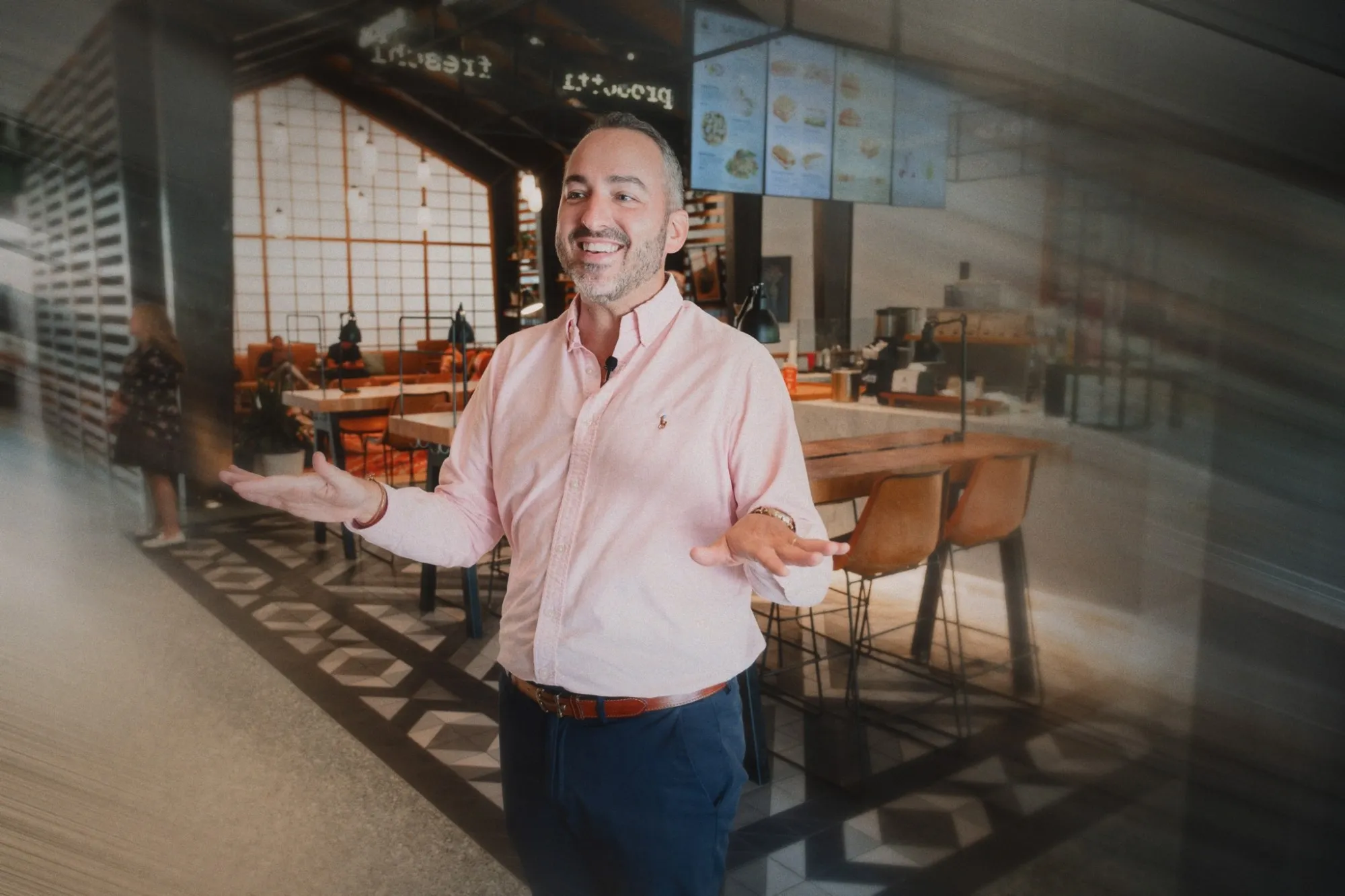
Aliya Khan, Marriott International’s Vice President of Global Design Strategy and Product Development, sits down with Dan Ryan of Defining Hospitality for a long-form Inner Circle conversation.

Sydney Webber
VP, Marketing

Still Working on the Train
She was still working on the train. Aliya Khan, Vice President of Global Design Strategy and Product Development at Marriott International, had been sent brand language for Residence Inn that morning and could not leave it alone. She called her team from between subway cars on the way to 12 Vestry Street: the brand is a kitchen table. You hang out there. You have breakfast there. Maybe two people sit and have coffee. It gathers. It is uncomplicated. It is simple. So stop making it sound like a tech feature.
“Why,” she would ask the room a few hours later, “are we calling it Dynamic Something-Something?”
The room laughed. But the laugh had something else in it: recognition, or the particular discomfort of hearing said plainly a truth you have been circling for years.
Aliya Khan is not the first person to walk into a room full of apartment operators with lessons from the hotel world. She may be the first to come with raw vulnerability and curiosity you’d never get from a conference keynote.
“Why are we calling it Dynamic Something-Something?”
Aliya Khan
Vice President of Global Design Strategy and Product Development, Marriott International
From Six Brands to Thirty-Some
Dan Ryan introduced her, having watched her career from the beginning with the particular pride of someone who knew before everyone else. He’s known Aliya for nearly twenty years, since she was at Starwood Hotels and Resorts.
He describes her career as parabolic, the kind of arc that starts quietly and then shoots sharply upward. Starwood was, for a stretch in the early 2000s, arguably the most innovative hotel company in the world. They created W Hotels. They developed the Heavenly Bed. There were six brands when Aliya arrived. Then came the Marriott acquisition in 2016, and the portfolio became something else entirely: thirty-some brands, more than 9,000 properties across 144 countries, and a loyalty program with over 228 million members.
Her job, roughly translated, is to decide what each brand is, who it is for, and how every physical and experiential choice serves that definition. She describes herself, with deliberate precision, as not Legacy Marriott. The distinction matters. The people who have been there for thirty years are one thing. The people who arrived in the last decade are something slightly different: the ones who do not want the company perceived as dated, who are asking harder questions about who the customer is becoming.

Do One Thing Well
Marriott has thirty-some brands because each one is a commitment. Residence Inn is for the extended-stay traveler who wants something that feels like home. Element is for the health-conscious guest. W is for the person who once wanted the hotel to feel like a club, but has since grown up without losing a sense of style.
citizenM, which Aliya describes with genuine admiration as smart, technology-driven, and replicable, runs three hundred rooms with a staff of just twelve. For context, a comparable hotel of similar size typically employs a hundred or more people across departments. That scarcity forces citizenM to overcompensate on training and human connection in ways most hotels never have to think about.
Each brand is designed, explicitly, at the expense of the psychographic it is not trying to serve. “The moment we force one brand to do everything,” she says, “we are being disingenuous and disrespectful.” “Do one thing. But do it really well.”
Multifamily has not, for the most part, done this. The industry has built thousands of buildings attempting to be everything simultaneously: wellness-forward and family-friendly and tech-first and community-driven and boutique-feeling and institutional-quality. A handful of operators have attempted sub-branding strategies with real results. Most have found the differentiation harder to execute than to envision.
“Do one thing. But do it really well.”
Aliya Khan
Vice President of Global Design Strategy and Product Development, Marriott International
The second hard thing is about data.
Hotels have it in abundance. Every night is a transaction. The feedback is immediate and granular. Marriott’s ITR, Intent to Recommend, is the number the entire organization lives by. Aliya describes the Marriott Transformational Capital Program in which Host Hotels & Resorts invested $800 million in targeted improvements at specific hotels across Marriott’s portfolio, each decision chosen based on data, validated through physical models that housekeeping, ownership groups, and maintenance crews all walked through before a dollar moved.
Phase II is underway for an additional $200–300MM.

Someone in the room offers, almost as a confession: the multifamily industry’s average survey response rate is approximately five percent.
Aliya does not pile on. She does not need to. Marriott makes decisions about Formica color based on decades of nightly feedback from tens of thousands of properties. The multifamily industry is, in too many cases, waiting for someone to hand back their keys before asking whether anything could have been better.
A History Lesson
There is a history lesson embedded in the afternoon, and Aliya delivers it without making it feel like one.
For most of its existence, the hotel was exactly what the word implies: a transactional waystation. A clean bed and a clean shower. The lobby was where you waited for your traveling companion to come downstairs. Nobody lingered. Nobody was meant to.
That began to change in the 1990s, when two hoteliers arrived at roughly the same insight from different directions. Ian Schrager, who had co-founded Studio 54 before reinventing himself as the creator of the American boutique hotel, and Barry Sternlicht, who would build Starwood Hotels and originate the W brand, both started asking a different question: why were hotels creating spaces that served only the guests sleeping upstairs? What if the bar and the common areas were compelling enough that people who lived nearby wanted to come? What if the local became the signal to the traveler that this was somewhere worth staying?
“If it’s good enough for a local to come here,” she says, channeling the original logic, “a traveler thinks: I want to stay there too.”
But Sternlicht went further. He did not want his guests to feel like they were in a hotel. The first team hired for W came from Pottery Barn. Their brief was simple: what is good about home? How do you give someone beautiful escapism that still feels residential?
The Heavenly Bed, Westin’s signature product innovation introduced in the late 1990s and still one of the most studied decisions in hospitality history, is, when described plainly, a bed. Dan says this with the pleasure of someone who has been saving the line: “Hospitality’s most innovative achievement of a generation was a bed. Because you go to a hotel to sleep.” Aliya laughs and agrees. Sometimes the obvious thing, done exactly right, is the revolutionary thing.
Multifamily has been watching this evolution for thirty years and borrowing its vocabulary. What has not fully transferred is the hardest piece: the operational commitment to making the experience matter, built into standards and training and daily practice, not just into the lobby renovation.
“Hospitality’s most innovative achievement of a generation was a bed. Because you go to a hotel to sleep.”
Dan Ryan
Host, Defining Hospitality
What Hotels Will Never Have
Marriott has visited apartment operators specifically to study what they are doing. They reached out to Bozzuto some years ago to understand how they created home. Not the feeling of a hotel. Home.
“They wanted to know how we created home,” says Jamie Gorski, who was at Bozzuto at the time. The exchange went both ways.
There is a structural reason hospitality lags here, and Aliya is direct about it. “I think one of the places where hospitality is a laggard is by virtue of the transient nature of people’s stays. People are in and out.” Hotels can reset every twenty-four hours. That is an extraordinary laboratory for testing and iteration. But the experiment ends at checkout. You never see someone’s daughter grow up. You never become the place someone points to when they tell the story of their twenties.
The permanence that multifamily operators sometimes treat as a management challenge is, from where Aliya sits, something closer to a gift.
“The idea that you could build something a person carries through different life stages,” she says. “That is something we are always trying to solve for. But we can only solve it one night at a time.”
There is also the data of daily life, which hotels will never accumulate. Operators who are paying attention know where their residents eat, what they do on weekends, when they are home and when they are not. That is a fundamentally different kind of knowledge than nightly transactional data. The ancillary services, the neighborhood relationships, the texture of ordinary living: none of it shows up in a hotel’s checkout report.
And then there is community. Hospitality has studied it, envied it, and not solved it. Hotel guests do not build real friendships across rooms. They do not walk each other’s dogs or pick up each other’s packages. The particular stickiness of a building where neighbors actually know each other is not available at any hotel at any price point.
“You have longer access to the customer,” Dan says. “You just have not fully figured out what to do with it yet.”
She nods. It is the most generous thing said all afternoon, and also the most demanding.
“You have longer access to the customer. You just have not fully figured out what to do with it yet.”
Dan Ryan
Host, Defining Hospitality

Design for Love
Marriott’s operating philosophy, offered in the context of a larger conversation about what makes a brand endure, is four words: We design for love.
The rest of the sentence is: and when you design for love, the dollars will follow.
It sounds like a poster. It is also a rigorous framework. It means you do not start with the P&L, the asset manager’s spreadsheet, or the investor’s return targets. You start with a human being. You ask what they actually need. You trust that if you answer that question honestly and consistently and at scale, the financial outcome follows.
And the proof is in the decades. Marriott does not think of its guests as one-time customers or even annual ones. It thinks in lifetimes. A guest who discovers W Hotels in their mid-twenties, drawn to the energy, the design, the sense that the lobby is somewhere they actually want to spend time, is not necessarily a W guest forever. Life moves. They start traveling for business. They have children. Their idea of a good trip shifts from one kind of evening to one kind of morning. Marriott designs for all of it. The same guest who checked into W at twenty-five might be in a Westin at thirty-five for a conference, a Residence Inn at forty with kids in tow, and a Ritz-Carlton for a milestone somewhere in between. One identity. Thirty-some expressions of who they might be at any given moment.
The implication lands quietly in the room. Apartment operators rent by the year. Marriott rents by the night. And yet Marriott has a more deliberate strategy for staying close to its customer across a lifetime than most apartment companies do. A resident moves out after two years and the relationship typically ends. The operator who housed them through a new job, a new relationship, a new city, starts the next conversation with a stranger. In hospitality, losing track of a loyal customer that way would be considered a design failure.
“The brands have personalities,” she says. “They are siblings. We are solving for different types of travelers, and the moment we force one to do everything, we lose the plot.”
The question settles over the room quietly, even as the conversation moves on: what would it mean to design multifamily for love? Not for occupancy. Not for NOI. For love. What would actually change?
“We design for love, and when you design for love, the dollars will follow.”
Aliya Khan
Vice President of Global Design Strategy and Product Development, Marriott International
What Would Change
Here is what would change. The person at the front desk would know your name without being told. The maintenance team, the people most residents actually interact with, the ones who show up when something breaks, would be trained the way the best hotels train their staff: make eye contact, say hello, ask if there is anything else you need. Not as a script. As a standard.
The leasing office would not wait for you to hand back your keys before asking where you were going and why. Nobody would move out of an apartment without someone asking, sincerely and not as a checkbox, what could have been different.
The experience would not be designed around the transaction. It would be designed around the relationship.
Danny Meyer, who built some of the most beloved restaurants in New York before writing Setting the Table, has a concept he calls the Hospitality Quotient: the innate warmth and attentiveness that makes the best service professionals who they are. His argument is that this quality is not trained into people. It is recruited. You hire for it. “It’s not about incentivization,” Dan says. “It’s about selection.” The behaviors you want from your team cannot be manufactured from the outside in. They have to already exist.
The practical implication for multifamily is significant. If the industry wants to close the service gap with hospitality, the answer is not a new bonus structure. It is a different hiring philosophy. It is deciding, at the very front of the process, that warmth is a qualification.
Looking Ahead to 2036
Near the close of the session, Dan turns to the room with the question he has been building toward. If we were all sitting here again in 2036, what would you be disappointed we did not build? Did not adopt? Did not have the courage to start?
Aliya does not hesitate. “I would be disappointed if technology had overtaken the spirit of what we do,” she says. “Whether it is multifamily or hospitality or human engagement and community. Technology should light the way forward. I do not want it to dominate.”
It is the most precise thing said all afternoon, and the most broadly applicable. Both industries are navigating the same tension: how do you use technology to free people up for human connection without letting it replace human connection entirely? That is not a technical question. It is a values question. It is, at its core, a design question.
She came in with a great deal. She is leaving with something too: the community problem, the permanence opportunity, the texture of daily life that hotels will never accumulate. These are things hospitality has studied and envied and not cracked.
Multifamily has not cracked them either. But it has the ingredients, the time, and the access. It always has. The question is whether it will decide, finally, that these things are worth designing for.

Five Things Hospitality Got Right (That We Are Still Working On)
1. Selection over incentivization.
The best service cultures in hospitality did not get there by rewarding the right behaviors. They got there by hiring people who already had warmth as a natural state, what Danny Meyer calls the Hospitality Quotient. It cannot be manufactured from the outside in. It has to be recruited.
2. One north star metric.
Marriott’s ITR, Intent to Recommend, is the number everything else is organized around. It drives capital allocation, training priorities, and owner accountability. A consistent multifamily equivalent, applied seriously across an organization, would change how money flows in this industry.
3. The physical model.
Before Marriott launches a new room concept, they build it. Every stakeholder walks through it: housekeeping, maintenance, ownership groups. Decisions get made with physical reality in front of them, not a rendering. Most multifamily decisions about design and amenities are still made from renderings.
4. Consistency across a distributed system.
Marriott does not own most of its hotels. It franchises and manages. The guest does not know and does not care. They receive, whether in Duluth or Dubai, something that feels like the same brand. Training, standards, and accountability make the brand travel. Most multifamily operators cannot say the same across their own portfolios.
5. The nightly reset.
Hotels can test anything in twenty-four hours. New service ritual, new programming, new amenity offering: you know by morning whether it worked. Multifamily’s relationship with residents is longer and richer. But the feedback loop is slower, and too many operators have learned to live without one.
Sydney Webber VP, Marketing
Sydney Webber is VP, Marketing at Venn, with more than a decade in multifamily across leasing, marketing, and technology. She makes AI make sense for non-technical audiences, and speaks on how operators can set their brands apart to win new owners and grow their portfolios.
Connect with Sydney on LinkedIn