



Own Your Data with Venn, the AI Data Layer for Real Estate

Sydney Webber
VP, Marketing
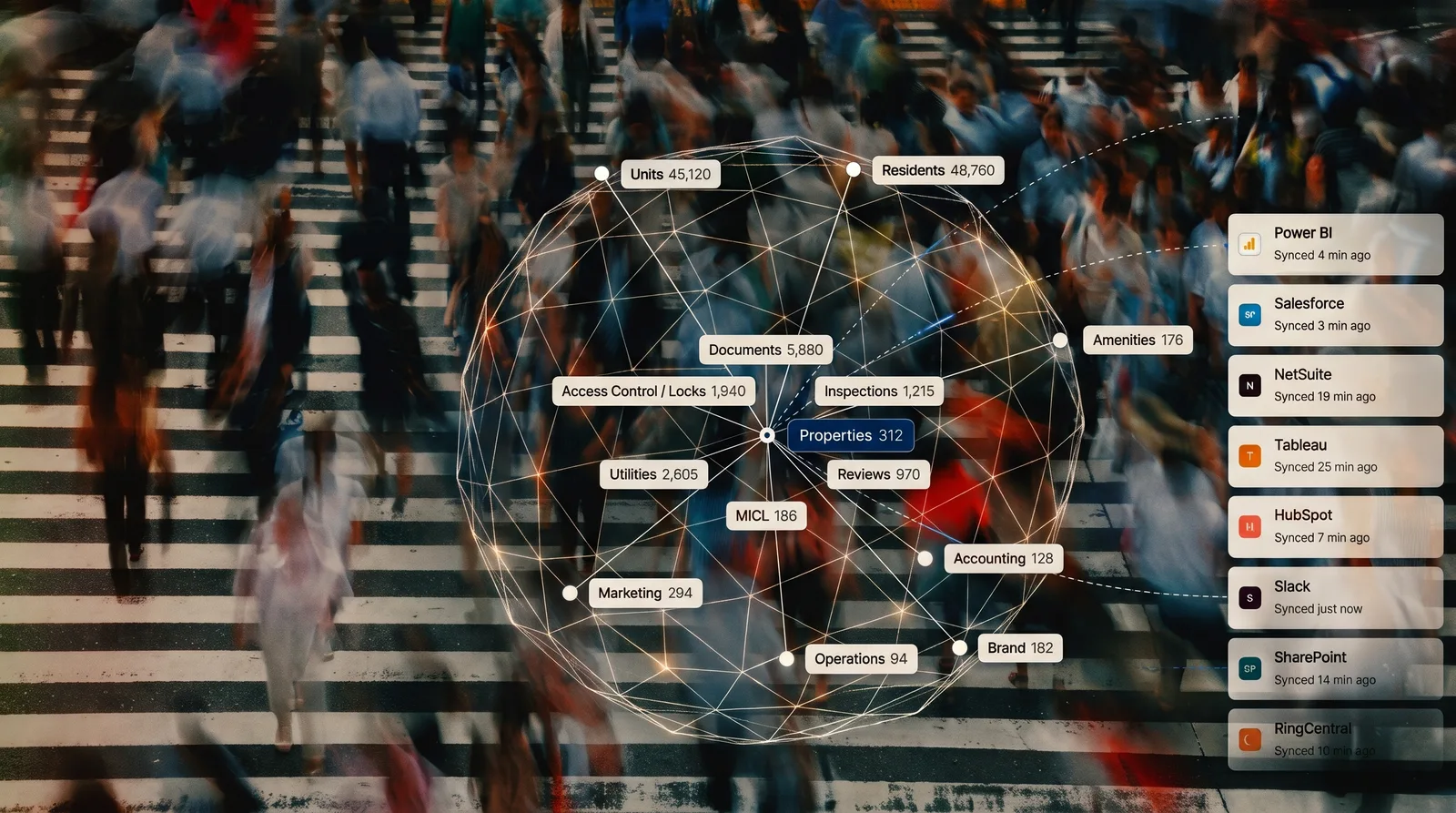
What is an AI data layer in real estate?
A real estate AI data layer is one private layer that connects every system an owner or operator runs, from the property management system to accounting, CRM and access control, and organizes that data around the company's own definitions. Single-purpose tools each keep a separate snippet of your data. An owned layer keeps the intelligence with you.
For multifamily owners and operators adding AI to leasing, maintenance and finance, this choice decides who holds the operating knowledge that makes your business different. Pick the wrong architecture and every workflow you build stays with the vendor that hosts it.
Key takeaways
- Single-purpose tools split your knowledge. Each tool keeps its own copy of resident, lease and work order data in its own format, so no AI sees the whole business.
- Models are a commodity; context is the moat. Every AI product sends data to a frontier model. What differs is whether that model works from your definitions and rules.
- Ownership means data, definitions and workflows. Owners and operators need to own their data and the knowledge it produces, not the vendor's platform or the underlying AI models.
- Housing raises the stakes. Applications hold SSNs, income, credit and household data, so an AI decision path you cannot audit is a Fair Housing and FCRA exposure.
- You do not have to rip and replace. An owned data layer sits above your existing PMS and tools through connectors, so teams keep the systems they already run.
Should real estate companies own their data or rely on single-purpose AI tools?
Real estate companies that run more than a handful of systems should own their data in one layer and let AI work from it. Single-purpose AI tools still fit narrow, isolated jobs.
The verdict depends on what you are trying to do:
- Own the data layer if you run several systems (PMS, CRM, accounting, access control, resident communication), report to investors or owners, or want AI agents that work across leasing, maintenance and finance.
- Stay with single-purpose tools if you need one capability in one department, have no plan to connect it to the rest of the business, and accept that what the tool learns stays inside it.
Most owners and operators land in the first group. Most owners and operators land in the first group. The average multifamily stack already spans more 20+ logins.
How do single-purpose software, operating systems and a Company Brain compare?
A real estate Company Brain keeps your data, definitions and decision history in one layer you own. Single-purpose software scatters them across many vendors. An operating system gathers them, but inside one vendor's platform.
| Factor | Single-purpose software | Operating systems (all-in-one suites) | Real estate Company Brain |
|---|---|---|---|
| What it is | One tool for one job, such as leasing chat or screening | One vendor's suite running many modules, such as PMS, accounting and leasing | An owned layer above every system you run |
| Where your data lives | A separate copy in each vendor's system and format | Inside one vendor's platform and data model | One private layer, kept separate from every other customer's data |
| Definitions and metrics | Each tool defines "occupancy" or "cost per lease" its own way | The suite's built-in definitions | Your definitions, used by every person, report and agent |
| What AI can see | One department or one channel | Data inside the suite; systems outside it, such as CRM, access control or other operating partners, are often missing | Leasing, maintenance, finance and resident history across every connected system |
| What happens when you switch | Workflows and history stay with each vendor | Changing suites typically means migrating data and rebuilding workflows | The layer sits above your PMS, so your context stays in place |
| Auditability | Decision paths hidden inside each product | Varies by suite | Decision logs and human review on automated actions |
| Brand and operating style | Each tool's default workflow | The suite's standard workflows at every property | Agents follow your policies, in your voice |
| Use of your data for AI training | Terms vary by vendor | Terms vary by vendor | Never used to train AI models |
| Setup | Fast for one use case | Long migration across the portfolio | Connects to existing systems; no rip-and-replace |
Single-purpose software and operating systems fail in opposite directions. Single-purpose software splits your operating knowledge across many vendors. An operating system consolidates it, but inside one vendor's platform and definitions, so the AI built into it knows that suite rather than your business. A Company Brain consolidates your knowledge in a layer you own, above whichever systems you run.
Why does data ownership matter more now that AI runs daily operations?
Data ownership matters more now because AI agents act on whatever context they are given, and single-purpose tools give each agent only a slice. Agentic AI is projected to automate 41% of real estate work hours, according to Business Journal.
As owners and operators race to add AI, three problems show up:
- Operating knowledge scatters. Your screening rules sit in one vendor, your renewal playbook in another, your maintenance priorities in a third. No single system holds the full picture.
- Your brand flattens into someone else's defaults. A leasing tool built for every operator answers prospects the way every operator would.
- Automated decisions get hard to explain. When an agent declines a request or prices a renewal, the reasoning lives inside a product you do not control.
The underlying AI models are now widely available. Every serious AI product sends data to one of a few frontier models. The difference between two operators using the same model is the context it works from: your data, your definitions and your rules. That context is the asset to protect.
What does owning your data actually mean for owners and operators?
Owning your data means you control your company's data, definitions, policies and workflows, and the knowledge they produce. It does not mean owning the vendor's platform or the AI models.
| You should own | You do not need to own |
|---|---|
| Resident histories, leases, work orders and financials | The vendor's software platform |
| Your definitions (what counts as a lease, a turn, an occupied unit) | The underlying AI models |
| Your policies and approval rules | The servers the models run on |
| Your workflows and the decisions agents make on them | Connectors and shared tooling the vendor maintains |
In practice, ownership comes down to four tests: your data is kept separate from every other customer's, it is never used to train AI models, you control who and what can access it, and it outlasts any single system you run.
How does a real estate Company Brain work as your data layer?
A real estate Company Brain is the owned data layer that single-purpose tools lack. A Company Brain is a living, connected memory of your real estate business. It brings the data from every system you run into one place, organizes it around your own definitions and rules, and makes it available to your people, your reports and your AI. (What is a Company Brain?)

Venn builds Your Company Brain as part of a five-layer Sovereign AI stack:
- Connectors. More than 60 connectors link the systems you already run, such as Yardi, Salesforce, NetSuite and SALTO. Most sync every 15 minutes, so information stays current.
- Data. Resident histories, leases and work orders are cleaned into one private source of truth.
- Context. Your definitions, metrics and guardrails, so "cost per lease" means one thing to every person and every agent.
- Agents. Agents take on coordination work across departments, with people handling escalations.
- Applications. Workspaces for site teams and a resident application in your brand.
Layers 2 and 3 are the Company Brain. The AI models are grounded in that context rather than trained on it. Over time the Company Brain accumulates context, feedback and memory, with human review, so each new agent starts from more of your business than the last.
What changes in daily operations when AI works from one owned layer?
When AI works from one owned layer, work that spanned three or four systems collapses into one flow. Published results from Venn customers show the pattern:
| Owner or operator | Workflow | Result |
|---|---|---|
| Kairoi Residential | Annual budgeting | Budget season trimmed down to two weeks from four months. |
| Charney | Move-in and approvals | Move-in from 6+ hours to under 1 hour; approvals in 10 minutes. |
| Veris | Site team operations | 7.5 hours a week saved per community; packages handled 40% faster; renewals up 4.3% in six months. |
| Venn Reclass Agent | Accounting review | Audits 126,000 journal entries a month. |
Each result depends on the same thing: the agent can see data from more than one system, read through the operator's own definitions. A budgeting agent that only sees the PMS cannot reconcile against the general ledger. A move-in agent that only sees the CRM cannot check access control.
For asset owners, the math compounds. At typical cap rates, $1 of added NOI is worth $20 to $25 of asset value, so hours saved and renewals gained show up in valuation, not only in payroll.
Why is data ownership a bigger risk in housing than in other industries?
Data ownership is a bigger risk in housing because rental applications hold some of the most sensitive data any business collects, under some of the strictest rules.
- The most sensitive data. One application can include an SSN, income, credit history, criminal history, bank details and household composition.
- Strict and local oversight. FCRA adverse action notices, Fair Housing Act disparate impact standards, local screening limits, CCPA and the Colorado AI Act all apply, and the rules change by property.
- Errors at scale. A biased leasing agent affects one applicant. A biased model affects every applicant at every property until someone notices.
When screening logic and decision history sit inside a vendor's product, an operator may not be able to show how a decision was made. An owned layer with decision logs and human review keeps that record with the operator.
This section is educational, not legal advice. Regulations change often; confirm current requirements with counsel.
What should you ask an AI vendor about data ownership?
Ask any AI vendor seven questions before you sign. Clear, written answers separate an owned data layer from a rented tool.
- Is our data kept separate from every other customer's? A good answer names how data is isolated, not only that it is.
- Is our data ever used to train or fine-tune AI models? The answer should be no, in the contract.
- Can we export our data, definitions and workflows if we leave? Ask for the format and the process, and what is excluded.
- What happens to our agents if we change our PMS? Workflows built above the PMS survive a switch; workflows built inside it usually do not.
- Can we see why an agent made a decision? Look for decision logs and a human review step on automated actions.
- Whose definitions does the AI use? If the vendor defines occupancy or cost per lease for you, your reports will not match your own.
- What security attestations do you hold? Ask for a current SOC 2 Type II report. Venn holds SOC 2 Type II.
When are single-purpose tools still the right choice?
Single-purpose tools are still the right choice when the job is narrow, contained and not tied to the rest of the business. Examples include a one-off marketing task, a single property pilot, or a function no other team relies on.
The trade-off is that whatever the tool learns stays with the tool. If you expect to connect that work to leasing, finance or reporting later, start with the data layer and add the capability on top.
Which approach is right for your portfolio?
The right approach depends on how many systems you run and whether you want AI to work across them.
- Choose a real estate Company Brain if you run several systems, report to owners or investors across operating partners, want agents that act across departments, or treat your way of operating as an asset.
- Choose an all-in-one operating system if you are ready to move every property onto one vendor's suite, accept its definitions and workflows, and run few important systems outside it.
- Choose single-purpose software if you need one contained capability, have no plan to connect it to other systems, and accept that its data and learning stay with the vendor.
- Combine them, in order, if you already run tools you like. Connect them to a Company Brain first, then decide which ones to keep.
5 reasons to own your real estate operating data:
- Single-purpose tools rent you AI; an owned data layer keeps the context yours.
- The model is not your advantage. Your data, definitions and way of operating are.
- Ownership is testable. Separate data, no model training, clear access control, and context that outlasts any one system.
- In housing, auditability is not optional. Keep decision logs and human review with the operator.
- Start with the layer, then add agents. Every agent built on a real estate Company Brain starts from more of your business than the last.
Venn is the sovereign AI platform for real estate. It turns a company's data, knowledge and operating practices into a Company Brain, then builds the applications and agents that run on it.
Talk to our team about building your Company Brain on the systems you already run.
Frequently Asked Questions
A real estate AI data layer is one private layer that connects every system an owner or operator runs and organizes that data around the company's own definitions. AI agents and reports then work from that shared layer instead of from separate vendor copies. See How does a real estate Company Brain work as your data layer?
Single-purpose tools make data ownership harder because each one keeps its own copy of your data in its own format. Your operating knowledge ends up spread across vendors, which makes it hard to see the whole business or change systems.
No. An owned data layer sits above your existing PMS and other systems through connectors. Venn connects to more than 60 systems, including Yardi, Salesforce, NetSuite and SALTO, with no rip-and-replace.
With Venn, no. Each customer's data is kept separate from every other customer's and is never used to train AI models. Models are grounded in your business context instead. Ask every AI vendor the same question and get the answer in writing.
A unified data layer makes AI more accurate because the AI sees all your data in one consistent format, read through your definitions. An agent can then check leasing, maintenance and finance together instead of guessing from one system.
Sovereign AI means the data, definitions and intelligence your AI builds belong to you. An off-the-shelf AI tool rents you a capability that runs on the vendor's defaults and keeps what it learns inside the vendor's product.
An owned AI data layer fits multifamily owners, asset managers and operators who run several systems and want their data and AI to stay theirs as the portfolio grows. Venn works with more than 270 owners and operators.
Sydney Webber VP, Marketing
Sydney Webber is VP, Marketing at Venn, with more than a decade in multifamily across leasing, marketing, and technology. She makes AI make sense for non-technical audiences, and speaks on how operators can set their brands apart to win new owners and grow their portfolios.
Connect with Sydney on LinkedIn