Perspectives
What Is a Company Brain? And Why Every Real Estate Operator Needs One
A Company Brain is a living, connected memory of your real estate business. Here’s what it does, why operators need one and how to start.

Chelsie Maki
Director of Communications
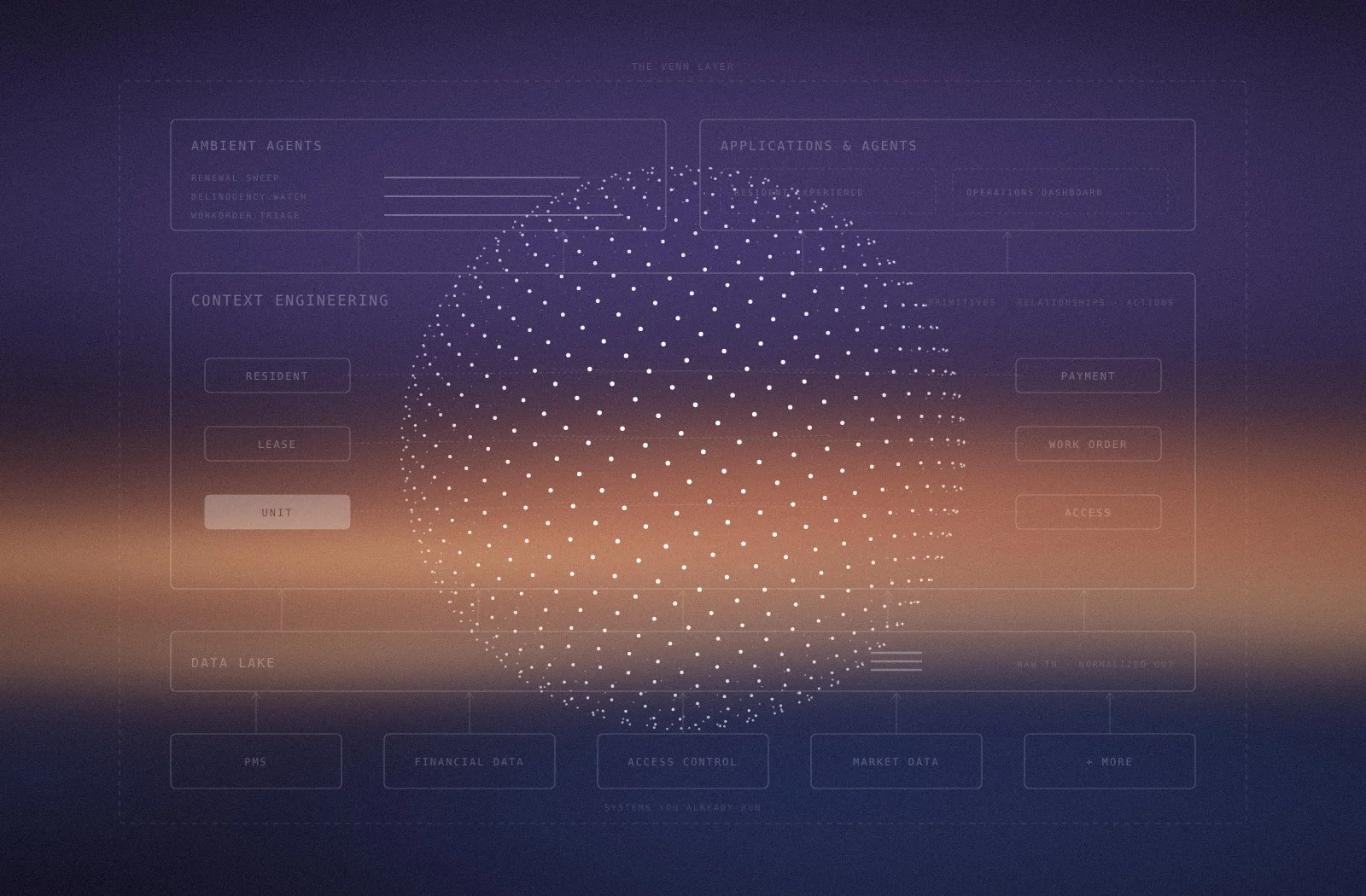
A Company Brain is a living, connected memory of your real estate business. It brings the data from every system you run into one place, organizes it around your own definitions and rules, and makes it available to your people, your reports and your AI. It’s the layer that actually understands your business, instead of just storing pieces of it.
If you’ve ever asked a simple question, like “How is this property really doing?” or “Why did renewals drop last month?”, and needed three systems, two spreadsheets and a day to answer it, you already know why it matters.
The problem: your business knowledge is everywhere (which means it’s actually nowhere)
Real estate runs on more software than ever. Owners and operators work across a property management system, a CRM, leasing tools, maintenance software, payments, access control, accounting, resident apps, reporting dashboards, and email and text threads that hold the rest.
Each system does its job. None of them sees the whole picture. And each one:
- Defines things its own way. “Occupied,” “delinquent” and “turnover” can mean different things in different tools, or at different operating partners.
- Holds only a slice of the story. The work order is in one place, the lease in another, the resident’s last three messages somewhere else.
- Learns only from itself. Whatever a tool figures out about your business stays inside that tool.
The result is familiar. Teams spend hours stitching data together by hand. Reports show up late and don’t match. New hires take months to learn “how we do things here.” And when you add AI, it either gives generic answers or hands the question back to a person, because it doesn’t have the context to do anything else.
What a Company Brain does
A Company Brain fixes the problem at the root by giving your business one shared memory. It does three things.
1. It connects everything you already run. The Company Brain plugs into the systems your teams use today, from your PMS to work orders, leases, payments, vendors and communications. There’s no rip-and-replace and no new system for your teams to learn. Venn’s Company Brain has more than 60 connectors to the systems operators already run.
2. It organizes everything in your language. Data from every source is normalized to your definitions: your chart of accounts, your metrics, your property names, your policies. When ownership asks a question, everyone, and every agent, answers it the same way.
3. It remembers, and gets smarter over time. Every resident conversation, work order, decision and outcome becomes part of your operating history. The longer the brain runs, the more it knows about what works at your properties, and the more useful everything built on top of it becomes.
On top of that foundation, you can run applications and AI agents that inherit everything the brain knows: dashboards for owners, command centers for operators, tools for site teams, and super agents that answer residents and get work done.
Why you need one
1. One version of the truth. When every system feeds one brain organized around your definitions, the numbers match. Owners, asset managers, operators and site teams stop arguing about whose report is right and start acting on the same picture.
2. AI that knows your business. AI is only as good as the context it has. A general model can write a nice email. An agent running on your Company Brain knows the resident, the unit, the lease, the open work order and your policy, so it can actually solve the problem.
3. Problems surface before they hit the P&L. With everything connected and current, risk shows up as it happens: a renewal at risk, a unit with repeat maintenance calls, a property drifting off budget. Your teams see it in time to do something about it.
4. Your teams get their time back. The hours spent pulling data, remapping reports and chasing context across systems go back to residents and properties. The same team can cover more units as your portfolio grows.
5. It compounds, and it’s yours. Most software spend stays flat or loses value over time. A Company Brain grows more valuable every month it runs. And because it’s built on your data, it should belong to you: grounded in your business, kept separate from every other company’s, and never used to train anyone’s models.
What it looks like across your business
- Owners and asset managers: one real-time view across every property and operating partner, in your own definitions. Ask a question about any asset and get an answer in seconds.
- Operators: one connected system instead of a dozen logins, with your rules applied everywhere. A team trained at one property knows every other one.
- Site teams: role-based views and agents that take on coordination work, like booking turns, chasing vendors and following up on rent.
- Residents: one experience in your brand, with answers and action any time of day, because the agent knows their lease, their unit and their history.
What this looks like in practice
Peter Febo, US Head of Asset Management at PHH, oversees 14,000+ apartments run by four different operating partners. His team used to spend its weeks pulling each partner’s data and remapping it by hand. On their Company Brain, built on Venn, all four partners now feed one view on PHH’s own definitions. They were live in 30 days, questions get answered in about six seconds, and the Friday watchlist and month-end rebuilds are gone. In Peter’s words, it’s “better than any BI dashboard I’ve ever had in my career.”
Operator example: Veris Residential rolled Venn out across its portfolio in 45 days. Package logging dropped from about 80 seconds to about 4 seconds per package, saving roughly 7.5 hours per community each week, and the resident app reached 90% adoption in its first month.
How to get started
- Map your systems. List every tool your teams use and what data lives in each.
- Agree on your definitions. Decide how your company defines its core metrics, before any AI starts reporting on them.
- Start with one high-impact use case. Portfolio reporting, resident requests, turns or renewals. Pick the place where manual work is heaviest.
- Ask who owns the intelligence. Make data ownership part of every technology decision.
Then expand. Every new application or agent you add runs on the same brain, so each one is faster to launch than the last.
Frequently Asked Questions
A Company Brain is a living, connected memory of your real estate business. It brings the data from every system you run into one place, organizes it around your own definitions and rules, and makes it available to your people, your reports and your AI. It’s the layer that actually understands your business, instead of just storing pieces of it.
Warehouses and BI tools store and visualize data for analysis. A Company Brain keeps your data connected, current and organized so people and AI agents can act on it in real time.
No. A Company Brain connects to the systems you already use. Your teams keep working in familiar tools while the brain ties them together.
AI can only be as useful as the context it has. Without your data, definitions and history, AI gives generic answers or escalates to a person. With a Company Brain, it can answer accurately and take action.
You do. Your data should stay separate from every other company’s and never be used to train AI models. Ask any vendor what you can take with you if you leave: your data, and your definitions and workflows.
It depends on your systems and first use case. PHH was live across four operating partners in 30 days, and Veris rolled out portfolio-wide in 45.
See what a Company Brain looks like for your portfolio. Talk to our team.
Chelsie Maki Director of Communications
Chelsie Maki is Director of Communications at Venn, leading press and company communications. Chelsie writes about Venn's customers, product launches, and company news.
Connect with Chelsie on LinkedIn