


Perspectives
Why Point Solutions Are Bleeding Your NOI: The True Cost of Multifamily Software Fragmentation

Kendrick Bradley
General Manager, Venn Leasing
Walk into any leasing office across high-supply submarkets right now—whether in Dallas-Fort Worth, Atlanta, Phoenix, or Charlotte—and you will see the exact same scene.
A Leasing Assistant sits behind two monitors with eight browser tabs open. One for the core multifamily property management software (PMS), one for the CRM, another for tour scheduling, two separate portals for fraud and screening, and a ticketing window for package management. Between handling walk-ins and phone calls, they spend half their afternoon copying the same prospect details from one window to another.
Over the past decade, multifamily operators deployed the "best-of-breed" software tools across departments. If an operational bottleneck existed, a specialized vendor built a point solution to fix it.
Now, the bill has come due. Instead of lean, hyper-efficient properties, operators are left with an expensive, tangled web of disconnected software. In an operating environment shaped by normalized rent growth, rising insurance costs, and sticky interest rates, this fragmentation isn't just an administrative annoyance. It is a direct, measurable drain on Net Operating Income (NOI).
Proptech is Evolving: From SaaS to AI Agents
For years, the industry treated multifamily property management software like a utility: buy a tool, hand it to site teams, and hope someone logs in enough to justify the monthly bill. But passive SaaS dashboards that require manual babysitting have hit their limit.
Today, proptech is moving rapidly from passive software to autonomous AI agents. We are moving away from tools that merely store information toward intelligent systems that actually do the work, answering prospect questions after hours, qualifying leads against specific credit policies, scheduling tours, and flagging renewal risks before a 60-day notice drops.
The catch? An AI agent is only as capable as the data feeding it.
If your screening data lives in one silo, your pricing engine in another, and your real-time unit availability inside a PMS that syncs once every 24 hours, adding a generic AI chatbot on top doesn’t fix anything. It simply exposes your broken workflows to prospects faster. To make AI work at the property level, the underlying operational infrastructure has to talk to itself in real time.
The Financial Impact: The "Hidden SaaS Tax"
Most multifamily property technology spending in multifamily bypasses tough scrutiny because of how it is billed: as a low, per-unit-per-month (PUPM) fee.
It starts innocently:
- $1.50/door for an automated messaging add-on.
- $2.25/door for a digital reputation dashboard.
- $3.00/door for advanced identity verification.
- $1.75/door for an off-site tour booking calendar.
Individually, these line items look negligible on a property-level budget. Collectively, operators across competitive metros are routinely spending $20 to $35+ per unit, per month on disjointed add-ons.
Here is what that looks like when capitalized:
For a mid-sized portfolio of 5,000 units, paying an unnecessary $20 PUPM in redundant software fees bleeds $1.2 million in cash flow annually. At a conservative 5.5% cap rate, that single administrative leak erodes nearly $22 million in portfolio value.
Beyond basic subscription fees, point solutions carry an invisible tax: custom API integration charges, annual contract escalators, and recurring consulting hours to patch broken connections whenever a core PMS pushes an update. You end up paying top dollar to maintain tools that duplicate half of what your existing platforms already do.
Operational Fatigue: Onsite Team Burnout
The software fragmentation tax doesn't stop at the balance sheet; your property teams pay for it every day in sheer exhaustion.
Site-level turnover in multifamily regularly hovers around 30% to 50%. While corporate teams often attribute this to compensation or market conditions, the daily friction of "swivel-chair" data entry is a massive, unacknowledged culprit. When a leasing consultant has to manually export a guest card from an outside marketing portal, verify income in an external dashboard, and re-type those same numbers into Yardi, RealPage, or Entrata, human error is inevitable.
Crucial details slip through the cracks:
- Concessions get misapplied on lease generation.
- Follow-ups drop off after day two because nobody checked the third-party inbox.
- New team members face a three-month learning curve just to master six separate tools.
Instead of building relationships with prospects and focusing on resident retention, your most expensive onsite talent spends its day playing data-entry clerk.
A Fractured Resident Experience
Renters do not know, or they care, what software stack you run. They only know when an experience feels clunky.
When a renter encounters a fragmented tech stack, the leasing journey feels disjointed from day one:
- They tour through a slick, third-party self-guided tour app.
- They apply on an entirely different web portal that forgets the floor plan they just walked.
- They get an automated screening email with a completely different brand header.
- Once moved in, they receive one login for rent payments, a separate app for package lockers, and a paper flyer for amenity reservations.
Every separate login, broken redirect, and mismatched communication is a drop-off point. A clunky digital onboarding process drives up vacancy loss and pushes acquisition costs through the roof.
The Asset-Level Risk: Delayed Decision-Making
At the regional & portfolio level, software fragmentation creates dangerous data blind spots.
When your data is scattered across five proprietary vendor dashboards, getting an accurate picture of trailing operational health is an uphill battle. Regional managers end up spending Mondays exporting conflicting CSV files, trying to reconcile why the CRM claims 14 leases were signed this week, but the core accounting ledger only shows eight cleared deposits.
By the time leadership catches a dip in true conversion rates or a spike in early-stage delinquency, weeks have passed. You are forced to operate on lagging indicators rather than proactive adjustments.
There is also the matter of legal exposure. In an increasingly litigious regulatory environment with stringent Fair Housing and tenant-data privacy regulations, scattering personally identifiable information (PII) across a dozen third-party vendors creates a massive compliance risk. If an external screening tool uses opaque scoring logic, the liability falls entirely on the asset owner, not the software vendor.
Strategic Blueprint: Venn’s Sovereign AI Infrastructure
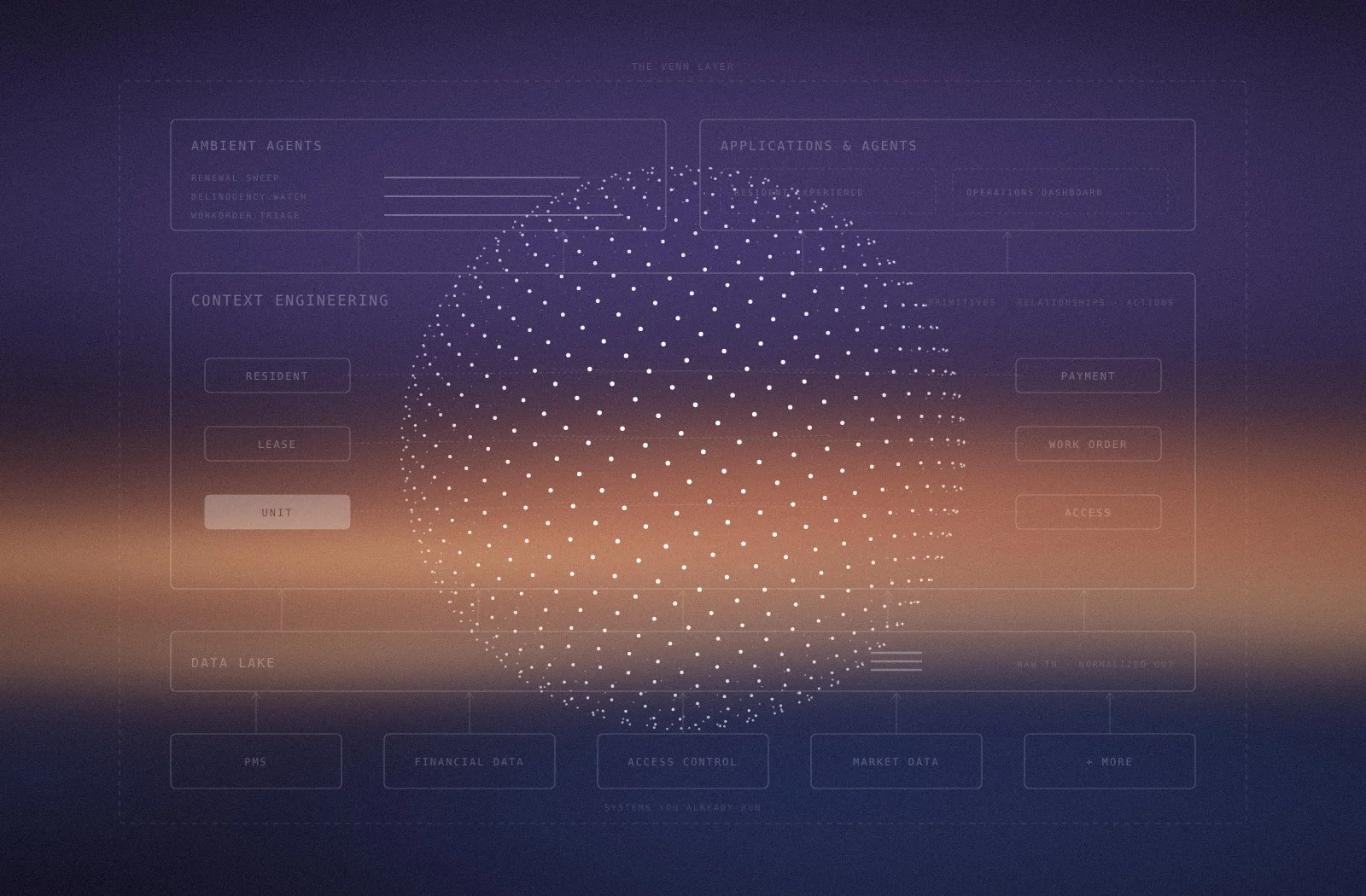
Fixing this problem does not mean ripping and replacing your core PMS, nor does it mean buying yet another point solution to act as a digital band-aid. It requires adopting a centralized, sovereign operational layer.
This is the principle behind Venn’s Sovereign AI Infrastructure.
Instead of forcing your staff to operate across siloed tools, Venn serves as the unified operational company brain for your portfolio. It connects natively to your existing PMS all while consolidating the fragmented stack of specialized point solutions underneath one intelligent layer.
What changes under a Sovereign AI framework:
- You Own the Operational Context: Rather than renting isolated algorithms from ten different software startups, you maintain complete ownership of your portfolio’s data, resident profiles, and operational logic.
- Autonomous, Brand-Aligned AI Agents: Venn deploys AI agents that actually execute operational tasks. Your AI leasing assistant doesn't just pass messages along; it understands your portfolio’s exact pricing parameters, qualification rules, and community voice, handling prospect communications and booking appointments 24/7 without creating duplicate guest cards.
- A Single Source of Truth: Every touchpoint, from first prospect click to maintenance dispatch and lease renewal, flows through one continuous resident journey. Site teams work from a unified dashboard, cutting out the swivel-chair data entry entirely.
- Audit-Proof Compliance: Because your operational intelligence is sovereign, automated decisions remain transparent, explainable, and fully compliant with federal Fair Housing laws and regional regulations.
Protecting the Bottom Line
Every dollar spent on redundant, disconnected software is an unforced error on your operating statement.
As the multifamily sector navigates supply waves and tightening margins, operational efficiency is no longer a luxury, it is the primary driver of asset valuation. Consolidating your tech stack and anchoring your properties with sovereign, autonomous AI eliminates administrative bloat, gives site teams their time back, and protects your NOI from death by a thousand subscriptions.
Take a deeper look at Venn’s Sovereign AI Infrastructure built to sit above your Property Management Software.
Frequently Asked Questions
Software fragmentation occurs when operators rely on disjointed, specialized tools for separate tasks (CRM, screening, touring, packages). This forces leasing teams into constant "swivel-chair" data entry across disconnected tabs.
Redundant tools create a "hidden SaaS tax" of $20 to $35+ per unit monthly. For a 5,000-unit portfolio, a $20 PUPM leak bleeds $1.2 million in annual cash flow—eroding nearly $22 million in portfolio value at a 5.5% cap rate.
Manual data duplication turns leasing specialists into data-entry clerks, driving 30% to 50% site turnover. The resulting administrative fatigue leads to costly errors, dropped leads, and misapplied concessions.
Deploying a centralized layer like Venn’s Sovereign AI Infrastructure. It connects natively to the existing PMS to consolidate disparate tools, eliminate duplicate data entry, and run autonomous, compliant AI agents from a single source of truth.
Kendrick Bradley General Manager, Venn Leasing
Kendrick Bradley is General Manager of Venn Leasing. Kendrick writes about Venn's latest product innovations in leasing and the thinking behind each release.
Connect with Kendrick on LinkedIn