Guides
Sovereign AI for Real Estate: A Guide for Operators
Who owns your resident data, your operating logic and the intelligence built on top of them, and why that question now decides the value of your portfolio.

Who owns your resident data, your operating logic and the intelligence built on top of them, and why that question now decides the value of your portfolio.
TL;DR: Key Takeaways
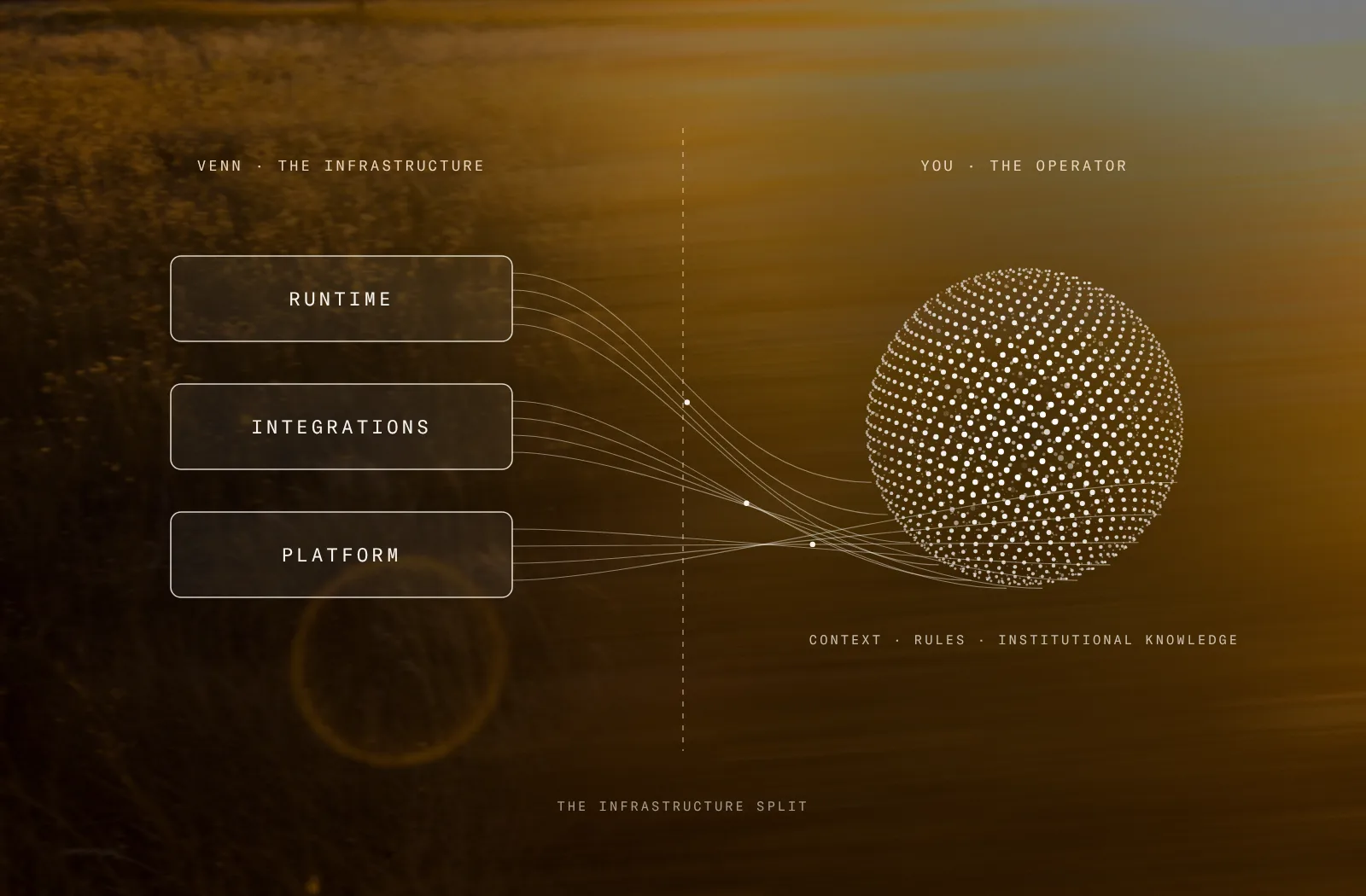
- What Sovereign AI Means: It is an independent, intelligence infrastructure (“Company Brain”) that holds your data, business definitions, policies and workflows, and keeps them independent of legacy Property Management Software (PMS).
- Renting a Tool vs. Owning Your Context: One-size-fits-all point solutions give AI limited knowledge of your business. They flatten your brand, make automated decisions hard to explain, and keep your operating knowledge locked inside each vendor.
- What Operators Gain: Faster execution, more capacity for onsite teams, a more consistent resident experience, and better financial performance.
- Mitigating Regulatory Risk: Operating across state lines demands complete audit trails. Sovereign AI helps operators show their work on Fair Housing Act (FHA) and FCRA obligations through decision logs and human review.
- PMS Portability: If you switch PMS tomorrow, your autonomous agents, context rules, and operational memory stay intact within your portfolio.
- The Core Blueprint: A sovereign stack connects to existing tools via five layers: Connectors, Data Cleansing, Context Engineering, Autonomous Agents, and Purpose-Built Applications.
Introduction
Agentic AI is projected to automate 41% of real estate work hours (BizJournal), driving a wave of new point solutions across multifamily. But as operators rush to deploy these tools, a quiet crisis is brewing: most are deploying AI that knows nothing about how their business runs, scattering their operating knowledge across vendors, and diluting their brand.
When you piece together a fragmented stack of off-the-shelf AI tools, you aren't building a proprietary advantage—you are spreading your operating knowledge across tools you don’t control. Accuracy still comes first, and accuracy depends on context. So alongside "Is this AI accurate?", property leaders need to ask "Where does our resident data go, who actually controls our operational logic, and what permanent leverage are we creating for our portfolio?"
The answer to those questions defines the next era of property technology: Sovereign AI.
The guide is written for multifamily owners, operators, asset managers, and operations leaders who support them. It moves from context (why now), to definitions (what sovereign AI means), to application (where it matters in multifamily), to risk (importance of data integrity), and finally to a practical blueprint and a checklist you can bring to your next vendor conversation.
Note: This guide is educational and is not legal advice. Regulations referenced here change frequently; confirm current requirements with counsel before making compliance decisions.
What is Sovereign AI in Multifamily?
At its core, Sovereign AI is a fundamental shift in ownership: moving from renting a tool to owning your context. Every AI product sends data to a model, ours included. What matters is whether that model works with your context, inside boundaries you set. Sovereign AI is an architectural framework that gives control and agency back to operators.
It gives you ownership over your data, your business definitions, your policies and your workflows (not over the vendor’s platform or the underlying models). Sovereign AI ensures that your workflows and unique business DNA as well as the resulting knowledge and efficiency stay inside your enterprise, ultimately building lasting value that belongs strictly to your portfolio only.
By contrast, relying on one-size-fits-all point tools exposes operators to real risk. Without strict operational boundaries, point tools can expose sensitive resident data to security breaches, and create immediate legal liability through unmonitored automated decisions. Worse, the workflows and rules you build inside each point tool stay with that vendor, diluting your brand, locking you into their ecosystem, and leaving you to rebuild your operating knowledge every time you switch.
Core Pillars in Multifamily
- Data Sovereignty: Sensitive resident data (including background checks, income verifications, lease terms, payment histories, and maintenance logs) is isolated per customer. Models may process it to do their work, but it is never used to train them.
- Model & Agent Ownership: The decision logic, custom prompts, orchestration workflows, and business definitions (the portfolio's "Company Brain") belong to the operator and can be exported. If an operator switches PMS providers, their operational AI and historical memory remain intact rather than getting locked into a vendor ecosystem.
- Operational Truth & Continuity: A persistent, trusted operational layer connects residents, units, leases, transactions, communications, maintenance, and decisions across fragmented systems. Every authorized AI agent works from the same governed context, with current information and a consistent history of what happened.
| Driver | One-Size-Fits-All Point Tools | Sovereign AI (Your Context Layer) |
| Data Control | Rules and history scattered across vendors; data terms vary by tool. | Isolated per customer and never used to train models; you control access and export. |
| Vendor Portability | Agents and workflows are lost if you change PMS or data systems. | High portability; sits as an independent intelligence layer above any PMS. Your data and configuration are exportable. |
| Regulatory & Auditability | Black-box decision paths make Fair Housing and FCRA compliance audits difficult. | Decision logs and human-in-the-loop review for automated actions. |
Why Does Data Sovereignty Matter in AI
While discussions around data sovereignty often default to security and compliance, the most critical operational stakes revolve around protecting your company’s identity. And AI that doesn’t know your business is one of the biggest risks to it.
If your AI isn't deeply integrated and grounded in your unique voice, tone, internal systems, and actual business DNA, then it is probably just copying someone else's identity and solving someone else’s problems.
Sovereign AI acts as the fortress for that DNA. By maintaining strict, private ownership over the proprietary data that grounds the models you use, you prevent your unique resident experience from being reduced to a model’s general-knowledge defaults. Ultimately, data sovereignty is what guarantees your automated interactions operate as an authentic, unmistakable extension of your specific brand, rather than a homogenized, off-the-shelf imitation.
Your operations strategy makes your communities unique
No two multifamily portfolios operate identically. Your operational playbook, from how your onsite teams conduct leasing tours and manage renewals to your specific approach to maintenance triage and resident engagement, is your primary competitive moat. One-size-fits-all point solutions threaten to flatten these distinctions by forcing every property into the same standardized workflows, turning distinct community cultures into interchangeable experiences.
To preserve what makes your portfolio special, your AI Agents must execute your exact operational strategy, not a software vendor's best guess. Sovereign AI allows you to own your portfolio's operational logic and use it to ground specialized AI agents that reinforce your brand at every touchpoint. Highly granular property and resident personal data is intrinsically bound to these custom intelligent workflows, but it is also exceptionally sensitive.
Why data sensitivity raises the stakes
Most verticals adopting AI handle some personal data. Multifamily handles nearly all of it at once: resident identity, income, employment, credit, criminal history, bank details, household composition and years of payment behavior.
This data is also tied to a decision with serious consequences. An AI-assisted screening or collections decision can determine whether a family gets housing or keeps it. Errors, bias or leaks do not just create a privacy incident; they can create a fair housing claim.
As AI moves from answering questions to taking actions (sending notices, scoring applicants, flagging fraud), each new use case widens the surface area. The more your stack depends on AI, the more it matters who controls the models, the data and the record of what happened.
Why Multifamily Is the Perfect Case for Sovereign AI
Multifamily real estate operates at the high-stakes intersection of physical environments, deeply sensitive human lives, and stringent legal oversight. Property systems have access to physical homes, to sensitive financial and to criminal histories. An AI answer built on wrong, stale or missing context isn't just a customer service glitch; it is a potential Fair Housing Act or FCRA violation. Because multifamily operators face this unique convergence of physical risk, legal exposure, and intense operational individuality, AI without your context is inadequate. Sovereign AI is not just a tech stack choice; it is an essential risk management and brand protection imperative.
The Data Multifamily Handles
A single rental application can contain more sensitive data than a typical bank account opening. Across a portfolio, operators routinely hold:
| Data type | Examples | Why it's sensitive |
| Personal Identity | SSNs, driver's licenses, passports, dates of birth | Core ingredients of identity theft |
| Income verification | Pay stubs, tax returns, bank statements, employer contacts | Financial detail, often on third parties too |
| Background checks | Credit reports, eviction history, criminal records | Regulated consumer reports; high bias risk |
| Payment history | Rent ledgers, autopay details, delinquency records | Financial behavior; used in future decisions |
| Lease terms | Occupants, pets, concessions, accommodations | Can reveal disability, family status, other protected traits |
| Resident communications | Maintenance requests, complaints, chat logs | May disclose health, safety or household details |
This data is not only personal but linked to sensitive outcomes that can damage a property to resident relationship. A reasonable-accommodation request reveals a disability. An occupant list reveals familial status. An AI system that ingests this data can learn patterns that correlate with protected traits even when those traits are never explicitly labeled.
Multifamily Regulatory Exposure
Multifamily operations sit directly in the crosshairs of strict federal, state, and local regulations. When you introduce AI into housing decisions, compliance doesn't disappear—it becomes much harder to demonstrate.
Key legal frameworks driving this exposure include:
- Fair Credit Reporting Act (FCRA): Tenant screening tools produce consumer reports. If an AI model scores or declines an applicant, you are still legally required to explain why and issue proper adverse action notices. Black-box AI makes proving standard accuracy or rationale extremely difficult.
- Fair Housing Act (FHA): Housing decisions cannot discriminate against protected classes. Under "disparate impact" rules, an AI model that inadvertently excludes protected groups creates immediate legal exposure—even if the algorithm had zero discriminatory intent.
- State & Local Tenant Screening Laws: Cities and states increasingly restrict how landlords evaluate applicants, such as placing limits on criminal history checks or enforcing source-of-income protections. A model only knows what it learned in training. Without the rules that apply to a specific property today as context, it can give a confident, non-compliant answer.
- Consumer Privacy & AI Legislation: Privacy laws (like California’s CCPA) and emerging regulations on high-risk AI (like Colorado's AI Act) target automated decision-making in housing. They grant residents rights over their data and demand rigorous oversight of automated tools.
- Data Security & Breach Mandates: Because property managers hold sensitive financial, identity, and background data, every state enforces strict breach-notification laws and cybersecurity standards.
Operating across state lines means navigating a complex regulatory patchwork. An AI tool without property-level context rarely reflects the hyper-local rules governing your specific properties, which leaves operators directly on the hook for compliance blind spots.
Reputational and liability risk at scale
The defining feature of AI is scale. A leasing agent who makes a biased judgment affects one applicant. A model that makes the same error affects every applicant it touches, across every property that uses it, until someone notices.
The same is true of breaches. A compromised AI vendor with access to your PMS can expose data on every resident in your portfolio at once, including former residents and rejected applicants whose data you may have forgotten you kept.
The consequences compound: regulatory penalties, class-action litigation, breach remediation costs, lost trust among residents and damage to relationships with investors and lenders who increasingly ask about data governance. For a portfolio of hundreds or thousands of units, a single systemic failure can outweigh years of efficiency gains. That is why every automated decision should be logged, explainable and reviewable by a human.
What Sovereign AI Looks Like in a Multifamily Tech Stack
Sovereign AI for multifamily is an intentional architectural framework designed to give operators control of their data, context and workflows. Rather than renting closed, "out-of-the-box" AI tools embedded inside legacy Property Management Software (PMS) platforms, a sovereign stack sits as a secure, independent intelligence layer above your existing software.
It keeps sensitive resident and property data within strict boundaries you define. It isolates information across portfolios or joint ventures, logs every automated decision for effortless auditing, and connects seamlessly across your operational tools without vendor lock-in.
Five core building blocks transform this vision into a multifamily reality.
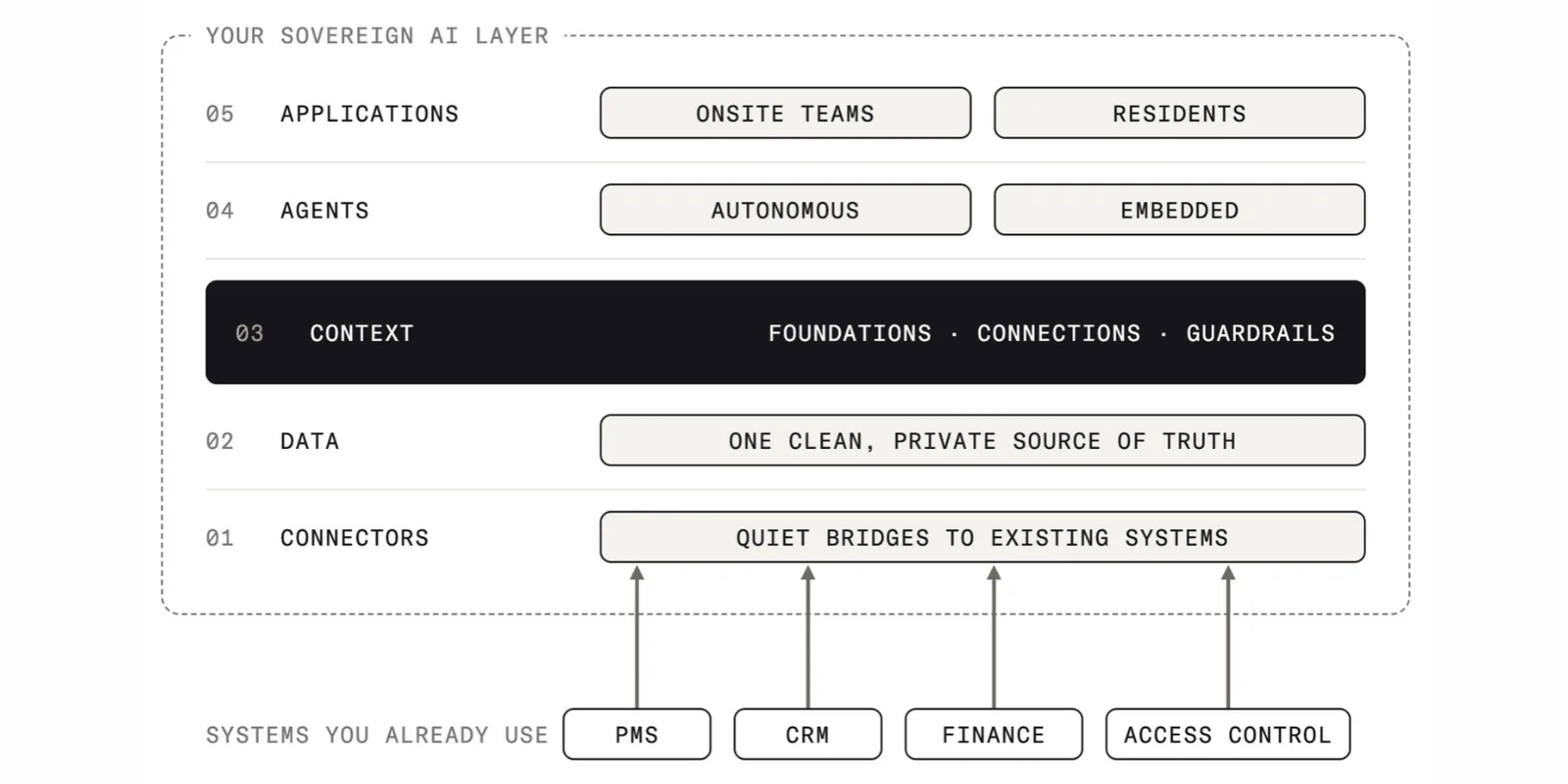
1. Your Connectors: Working with what you already have
Nobody wants to rip out their core software and force an entire workforce through months of retraining. Connectors act as quiet, invisible bridges to the systems your teams already use every day, things like Yardi, Salesforce, NetSuite, or SALTO. They hook into your existing software in the background without disrupting day-to-day operations. Their singular job is to ingest and surface raw data into your infrastructure layer.
2. Your Data: Cleaning up the daily information clutter
Property management data is notoriously scattered across emails, spreadsheets, and disconnected software tools. The data layer in an Sovereign AI Infrastructure gathers and cleans all those raw pieces of information (resident histories, leasing terms, maintenance requests, etc.,) into one secure, private rolodex. It automatically cleans and standardizes the information, giving your entire company a single, reliable source of truth so your team stops wasting time hunting down answers across five different tools.
3. Your Context: Teaching AI how your business actually operates
A model out of the box doesn’t know the realities of running your property. Context engineering translates your company’s specific operational style and rules into logic that the technology can actually follow.
- The Foundations: It defines the core elements of your day-to-day world. For example, what a “Lead,” "Resident," “Maintenance Request,” or "Unit" means in your organization.
- The Connections: It teaches the system how those pieces relate. For instance, it can combine marketing spend, team labor hours, and signed leases to give everyone a single, agreed-upon definition of "Cost Per Lease."
- Smart Guardrails: It automatically enforces privacy and permission rules, ensuring regional managers, property owners, vendors, and residents only see the specific information relevant to them.
The context of your operating model is likely part of what makes your business unique. It’s the operational DNA from which you derive your competitive edge, empower your site teams, and deliver standout resident experiences.
4. Your Agents: Digital teammates handling the grunt work
Think of AI agents as 24/7 digital teammates designed to take care of repetitive tasks so your human team can focus on high-value resident relationships and real decision-making.
- Background Assistants (Ambient Agents): They work silently behind the scenes, flagging upcoming lease expirations, monitoring payment anomalies, prioritizing urgent repair tickets, or following up with new leads.
- On-Demand Co-Pilots (Tools with Agents): They sit directly inside your staff's software, offering helpful prompts and guiding team members through complex tasks. They save hours of manual data entry by pre-filling routine paperwork, while flagging any items that require human judgment.
- Orchestrators (Super Agents): They aren't tied to any specific screen. Instead, they coordinate tasks across all of your other agents and applications, so you can get a single answer or action without switching between tools.
Unlike generic, off-the-shelf AI tools, agents grounded in your specific operational DNA build up context and memory about how your portfolio runs, refined through onboarding, team feedback and policy updates, with humans handling escalations. Custom-deploying them turns your company’s unique way of operating into a compounding operational differentiator that legacy tools cannot replicate.
5. Your Applications: Purpose-Built for Daily Operational Flow
Instead of forcing teams and residents to navigate rigid, outdated property management software, this top layer delivers clean, modern applications designed around how people actually work and live.
- For Onsite Teams: Staff get a seamless daily workspace that eliminates software fatigue. Rather than digging through complex menus across multiple systems, site managers receive an intuitive dashboard that surfaces exact, context-rich actions—allowing them to handle work orders, resident inquiries, and leasing tasks effortlessly within their natural workflow.
- For Resident Experience: Residents enjoy a clean, frictionless portal that feels as intuitive as the consumer apps they use every day. Submitting a repair ticket, tracking a request, or renewing a lease becomes an instant, transparent process, delivering a high-touch living experience with zero digital friction.
By bringing these five components together, Sovereign AI turns your operating knowledge into an asset that compounds. By decoupling intelligence from legacy systems and anchoring it in your own operational DNA, you retain ownership of your data and your logic. It turns daily operational efficiency into a compounding enterprise advantage, delivering an elevated experience.
Conclusion
The transition to Sovereign AI is not merely a technical upgrade. It is a fundamental strategic decision about who owns the enterprise value of your business. As AI shifts multifamily operations from manual labor to autonomous execution, relying on fragmented, one-size-fits-all point tools creates existential risks to your data security, regulatory compliance, and brand identity.
Sovereign AI gives control back to the operator. By unifying your connectors, data, context, agents, and applications into an independent intelligence layer, you convert legacy software into passive utilities while keeping your unique business DNA strictly under your control.
The operators who lead the next decade of multifamily real estate won't be those who adopted generic AI the fastest. They will be the ones who institutionalized their operational knowledge into a permanent, custom intelligence layer in order to build an unbeatable competitive advantage. One that empowers the onsite workforce and creates long-term value for their residents and partners.
The choice facing property leaders today is clear: Run AI that knows nothing about your business, or give it a Company Brain that does.
Ready to transform your real estate organization with Sovereign AI? Talk to our team.